Festival Toilets: Civilisation Measured in Portaloos
The grimmest logistics problem at any festival, and the one that tells you the most about it
Contents
You can tell everything about a festival from its toilets. Not the lineup, not the beer price, not the size of the main-stage screens — the toilets. By Sunday afternoon of a big four-day event, the state of the portaloos is a brutally honest readout of how much the organiser actually cares about the people in the field, how good the logistics team is, and how close the whole enterprise is running to the edge of chaos. It is the least romantic subject in live music and the single most useful thing nobody writes about.
So let me write about it. This is the piece I wish someone had handed me before my first Roskilde, when I was seventeen and learned the hard way that “I’ll just wait until it’s less busy” is not a strategy, it is a surrender.
The mathematics of a very bad queue
Start with the scale of the problem, because the numbers are genuinely staggering once you sit with them. A festival like Roskilde draws well over a hundred thousand people onto a patch of Danish farmland for a week. Every one of those people needs the toilet several times a day. There is no plumbing out there — the site is a field eleven months of the year — so everything must be trucked in, kept running for a week in summer heat, and trucked out again, all while a small city’s worth of people use it constantly.
The rough industry rule of thumb is one toilet per seventy-five to a hundred people for an event of that length, which sounds generous until you do the arithmetic. Even at a well-provisioned festival, a hundred thousand attendees means somewhere north of a thousand units, and they still develop queues, because human bladders do not distribute their demand evenly across the day. Everyone needs the toilet in the same two windows: first thing in the morning when the campsite wakes up, and in the twenty-minute gap between the two biggest bands of the night. The infrastructure could be twice the size and those two rushes would still produce a queue you could measure in fields.
This is the hidden logistics war that every festival is quietly fighting behind the music. Servicing a thousand toilets means a fleet of tanker trucks moving through the site on a schedule, sucking out and refilling, all night, every night, along access roads that also have to carry stage equipment, medical vehicles and beer deliveries. When a festival “feels well run”, a huge and invisible part of that feeling is that the sanitation crews are winning. When it feels like it is falling apart — and I have written about how so many festivals now feel eerily the same, sanded down to an identical experience — one of the first cracks to show is always the toilets. The queue is the tell.
A taxonomy of the horror
Not all festival toilets are the same species, and knowing the local fauna helps you plan.
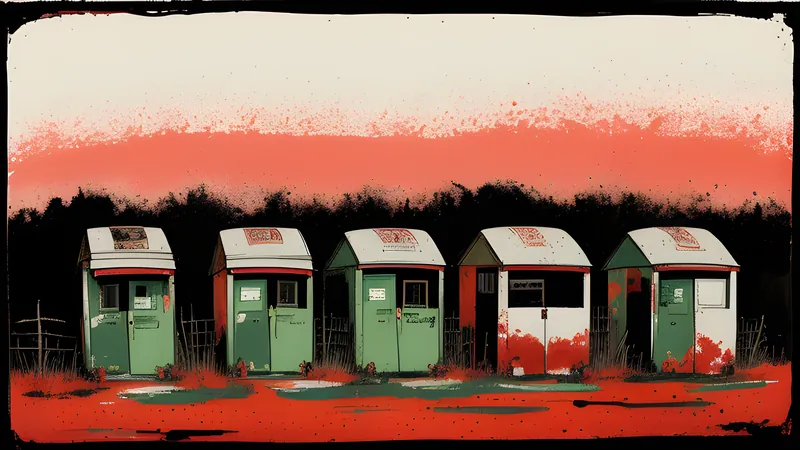
The standard portaloo is the plastic booth everyone pictures: a tank of blue chemical liquid, a moulded seat, a door bolt that works about half the time. Fine on Thursday morning. A test of nerve by Sunday, when the tank is high and the heat has done its work. The blue chemical is doing real chemistry in there — it is a biocide and deodoriser fighting a losing battle against volume and temperature, and by day four the battle is lost.
The long-drop is the Glastonbury classic: a raised trench with a row of seats over it, no chemicals, just gravity and a very deep hole. Grim to look into, but paradoxically often better by the end of a festival than a chemical loo, because there is so much more capacity beneath you — nothing to overflow, nothing to slosh. The trade-off is the view. Do not look down. Nobody looks down.
The compost toilet is the ethical upgrade that has spread through the greener end of the festival world, and it genuinely works: you do your business, throw in a scoop of sawdust or wood shavings from the bucket, and the whole lot is later composted into something safe and useful. They smell far better than a chemical loo because the sawdust locks everything down, and they turn the entire problem into fertiliser. The catch is discipline — one scoop, every time, from everyone — and discipline is exactly what a field full of people three days into a festival does not have.
And then there is the urinal trough, the long steel or plastic gutter that exists for one reason: to keep the men out of the toilet queues so the toilets are freed up for everyone. It is undignified, it is efficient, and it is one of the more genuinely useful pieces of festival design ever invented. It also, crucially, keeps people from wandering off to relieve themselves in the hedges, which matters more than you would think.
The wild-wee problem is an ecological one
That last point deserves its own section, because it is where festival toilets stop being comedy and become genuinely serious. When the queues get bad, a certain number of people give up and go behind a tent or into a ditch. It feels harmless. It is not.
Glastonbury has campaigned hard against wild weeing for years, and the reason is not squeamishness — it is that the festival sits in a river catchment, and the sheer volume of urine soaking into the ground from a crowd that size can wash into local streams and harm the water and its wildlife. When two hundred thousand people are in one valley, individual biology becomes an environmental event. Festivals hand out “pee funnels”, plaster the campsite with signs, and put urinals everywhere precisely to keep it out of the watercourse. The toilet infrastructure is doing ecological work as well as bodily work. The trough by the fence is protecting a river you cannot see.
This is the part I find genuinely admirable about the best-run events. Somewhere in the organisation there is a person whose entire job for a year is thinking about where a hundred thousand people’s waste goes, how to move it, how to keep it out of the groundwater, and how to turn as much of it as possible into something useful. They will never be thanked. Their success is measured entirely in the absence of disaster. And they are, in a real sense, holding the festival’s civilisation together with tanker trucks and sawdust.
How to actually survive the field
Since this is meant to be useful, here is what a couple of decades of Danish fields has taught me.
Go early and go tactically. The best time is mid-set, when everyone else is watching a band. The worst is the changeover between headliners, when the entire site has the same idea at once. Sacrifice ten minutes of a band you half-like to hit the loo while the good band is still on, and you will skip a queue that would otherwise cost you the start of the show.
Bring your own supplies. The single highest-value item in any festival bag is your own toilet roll, because the communal roll vanishes by Friday and never returns. Hand sanitiser, likewise. A head-torch for the night trips. These three things cost nothing and improve your festival more than any amount of expensive camping kit.
Learn the map. Every festival has toilet blocks that everyone uses and blocks that everyone forgets. The ones near the main stage and the main campsite gates are permanently mobbed. Walk five minutes to the edge — the block behind the food court, the one at the far end of the quiet campsite — and you will often find a short queue and a cleaner booth simply because fewer people bothered to walk. At Roskilde, whose whole gloriously non-profit ethos extends to genuinely trying to look after the people in the field, the outlying blocks are your friends.
Manage your own inputs. This is the unspoken one. The amount of warm lager going in is directly related to the number of trips out, and every one of those trips is a queue in a hot plastic box. Pace yourself and your afternoon improves in ways that have nothing to do with the music.
The truest measure of a festival
Anyone can put on a good show when everything is dry and fresh on Thursday. The real test of a festival is Sunday afternoon — hot, four days in, the site tired, everyone slightly feral. Walk into a toilet block at that moment and you learn exactly how much the organiser respects you. Are the units serviced, restocked, still bearable? Or has the whole system been left to rot because the money went on pyrotechnics and the toilets were an afterthought?
I have been to festivals that spent a fortune on the stages and clearly regarded sanitation as beneath their notice, and I have been to smaller, poorer events where the compost toilets on Sunday were somehow more pleasant than the chemical loos had been on Friday, because someone cared and someone kept scooping. Guess which ones I go back to. The lineup gets you through the gate once. The toilets decide whether you ever come again. It is the least glamorous truth in live music, and it is the one that has never once let me down.
Related Content