DR Koncerthuset: When the Loud Books the Concert Hall
Jean Nouvel's blue meteorite in Ørestad, and what happens when amplified music walks into a room built for silence
Contents
Take the Metro out to Ørestad and you surface into a stretch of Copenhagen that still feels half-finished, all glass office slabs and wide empty plazas and a wind coming off the flat reclaimed land that never quite stops. Then you see it: a great dark box wrapped in blue-tinted mesh, the whole facade rigged to glow and shift colour after dark like a screen the size of a building. That is DR Koncerthuset, and the first thing worth saying about it is that it looks like nowhere else in the city. The second thing worth saying is that it was built for a kind of music I mostly don’t go and see — and the interesting question, the one this whole piece is really about, is what happens when my kind of music turns up anyway.
Because it does. This is a house designed around the unamplified symphony orchestra, tuned to within an inch of its life for sound that arrives with no speakers in the way. And every so often the bookings tilt toward the plugged-in world — a singer-songwriter, a synth act, a film-score night, some careful crossover thing — and the room has to answer a question it wasn’t asked at the drawing board. Sometimes it answers beautifully. Sometimes you can hear the seams. Both are worth understanding if you’re the kind of Copenhagen gig-goer who usually lives in sweatier rooms.
The blue meteorite in Ørestad
DR Koncerthuset opened in January 2009 as the crown of DR Byen, the sprawling headquarters the Danish Broadcasting Corporation built for itself out on Amager when it consolidated its scattered operations under one roof. The concert hall is the showpiece, designed by the French architect Jean Nouvel, and it arrived with the sort of budget overrun that gets talked about for years — one of the more expensive concert halls of its era, a number that made headlines and raised eyebrows across a country that generally frowns on that kind of spending. Whatever you think of the price tag, they got a landmark out of it.
The exterior is the part everyone photographs. Nouvel wrapped the building in a blue fibreglass mesh screen, and at night the thing becomes a projection surface — images and colour washing across the whole face of it, so the hall reads from a distance like a glowing block dropped out of the sky. People call it the meteorite, and the nickname sticks because it’s accurate: it has that quality of something that landed rather than something that was built. In the daylit flatness of Ørestad, surrounded by the newer glass towers, it holds its own by being stranger than all of them.
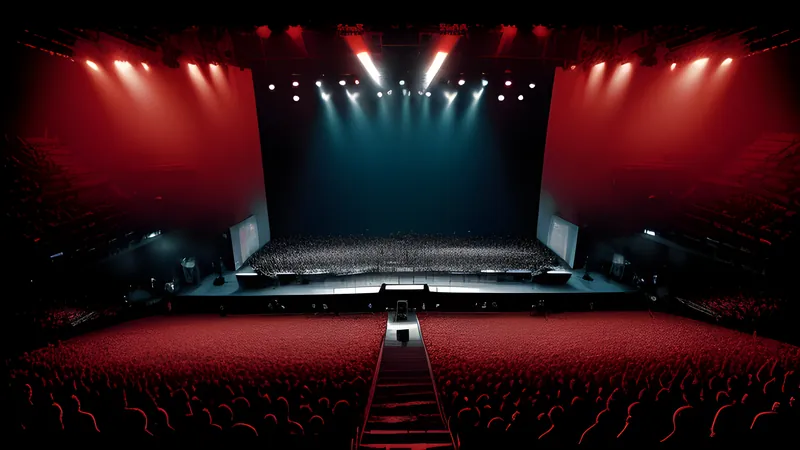
Inside, the concert hall proper — Koncertsalen, the room DR also files as Studio 1 because the whole complex doubles as broadcast infrastructure — seats somewhere around 1,800. It’s a vineyard-style hall, which is the design where the audience isn’t parked in one block facing a stage but terraced in banked sections that climb up and wrap around the orchestra on multiple sides. Berlin’s Philharmonie is the famous ancestor of the form. The idea is intimacy at scale: nobody is very far from the players, and the sound has short distances to travel in every direction. Sit up behind the stage and you’re looking at the conductor’s face and the backs of the musicians, which is its own education.
Toyota’s room, and why the silence matters
The name to know here is Yasuhisa Toyota, the acoustician from Nagata Acoustics who has tuned a remarkable share of the world’s best-regarded modern halls — Walt Disney Concert Hall in Los Angeles, the Elbphilharmonie in Hamburg, the Suntory Hall lineage in Tokyo. Copenhagen’s is one of his. And once you know that, the whole room starts to make sense as a machine with a single purpose: to take sound that has no electricity behind it and deliver it, whole and warm and detailed, to 1,800 people at once.
That’s a genuinely hard problem, and the solutions are everywhere if you look. The banked vineyard geometry keeps sightlines and sound paths short. The surfaces are shaped and angled to scatter reflections so the sound arrives as an even wash instead of a slap-back. There’s careful control over reverberation time — long enough to give an orchestra bloom and body, short enough that fast passages don’t turn to mud. Every material in the room is doing acoustic work. When it’s empty and quiet you can feel how alive the space is; a single cello in there sounds like it’s been lit from inside.
Here’s the thing that took me a while to properly get: a hall this good at acoustic music is, by the same design choices, a slightly awkward host for loud amplified music. The two jobs pull in opposite directions. An orchestra wants a long, generous reverb tail to sound rich. A rock band wants a fairly dead room so the PA — not the walls — controls the sound, so that a distorted guitar and a kick drum stay tight and defined instead of smearing into the reflections. Put a wall of amplification into a space engineered to make sound linger, and physics does exactly what you’d expect. The room keeps ringing when the band wants it to stop.
This is why the best-sounding rock room in town works on completely different principles. When I’ve raved elsewhere about VEGA being Denmark’s best-sounding room, the whole point was that VEGA is built to serve a PA — a mid-size hall where the amplified sound is the sound, and the room stays out of its way. Koncerthuset is the opposite philosophy carried to a world-class extreme. Both are brilliant. They’re just brilliant at different jobs, and knowing which is which saves you from a disappointing night.
What actually works in there when you plug in
None of that means amplified acts have no business in the building. Plenty do, and the smart bookings are the ones that read the room correctly. DR’s own programming leans on the strengths — the DR Symfoniorkestret is the resident orchestra, the DR choirs and big bands are in and out, and the pop and jazz that turns up tends to be the sort that can live with a live-sounding room instead of fighting it.
The acts that thrive share a quality: dynamics. A singer-songwriter who can drop to a whisper and have it carry to the back row is using the exact thing the hall does best — that long, detailed decay turns a quiet passage into something enormous. Solo pianists, string-led arrangements, folk and Nordic acoustic music, the kind of electronica that’s more texture than assault, film-score and game-music nights with an orchestra on stage — these are Koncerthuset’s amplified sweet spot. Classical-crossover in general is a natural fit, because it’s writing that already assumes a hall like this. When the material breathes, the room breathes with it, and you get a listening experience you simply cannot buy in a flat-floored club.
The seating is part of the deal, and you have to make peace with it. This is a sit-down house, banked and reserved, and there’s no standing floor to surge on. For the right show that’s a gift — you’re pinned in your seat, phone away, actually listening, with none of the shuffle-and-chatter of a bar-at-the-back club night. For the wrong show it’s a straitjacket. There’s a particular species of gig where the music is telling your body to move and the architecture is telling it to stay seated, and that tension can quietly kill a room. I’ve felt it. The trick, as punter, is to book yourself only into shows that want you sitting.
The smaller studios widen the range. The complex isn’t just the big hall — there are further studios, the intimate rooms DR uses for chamber music, jazz and more modestly scaled pop, and they change the maths entirely. A jazz trio or an intimate songwriter in one of the smaller spaces is a completely different, more human-scale night than anything in the 1,800-seat main room. If you’re eyeing a show here, always check which room you’re actually in; it matters more than the headline name on the ticket.
Where it falls down, honestly
Now the part where I stop being polite about the building. A full metal band does not belong in DR Koncerthuset, and I say that as someone who spends most of his year in exactly the rooms where they do belong. Take a proper loud act — down-tuned guitars, double-kick drumming, a vocalist built for volume — and put them in a hall engineered to make every sound hang in the air, and the low end turns to soup. The reverberation that makes a cello glorious makes a blast beat unintelligible. The kick and the bass smear into each other, the guitars lose their edges, and the whole tight, brutal architecture of heavy music — which depends on precision and separation — collapses into a warm grey roar. You’d be better served by nearly any club in the city.
For that kind of night Copenhagen has the right tools already, and they’re the ones I’d point you to instead. When an act gets genuinely huge you want a room built to move air at scale, like Royal Arena out here in the same Ørestad district, a purpose-built modern shed that swallows a big production without complaint. And for the mid-size touring show — the band too big for the clubs and too small for the arena — Amager Bio across the water on Øresundsvej is close to the platonic ideal, a sloping cinema floor built to serve a PA and let a crowd surge. Neither is trying to be a symphony hall, and that’s precisely why they work for loud music. Koncerthuset is trying to be a symphony hall because it is one, and the honest verdict is that its greatness is narrow and specific rather than universal.
There’s a practical strike too: Ørestad is a hike, and it feels like one. The Metro gets you there efficiently enough, but the neighbourhood around the hall has none of the pre-gig ecosystem you take for granted in town — no clutch of bars to warm up in, no obvious place to spill out to afterward, just wind and plazas and the long ride back. A great show carries you through it. A merely decent one leaves you standing on a cold platform wondering why you didn’t just stay central.
The verdict from a loud-music lifer
So where does that leave a Copenhagen gig-goer who mostly lives in the sweaty end of the spectrum? With genuine respect, and a filter. DR Koncerthuset is one of the best-sounding rooms in the country — arguably the best, at the one thing it was built to do — and that alone makes it worth the trip when the booking suits it. Toyota’s acoustics are not a marketing line; they’re audible from the first bar, and for a dynamic act with the range to use them, the hall gives you something no club in this city can. A quiet passage in that room will raise the hair on your arms.
The discipline is in the booking. Read the show before you buy: if it’s an act that breathes, that trades on dynamics, that wants you sitting still and listening, this is one of the finest places in Northern Europe to hear it. If it’s an act that wants your body moving and your ears assaulted, go somewhere built for that and let Koncerthuset do what it does best. The blue meteorite out in Ørestad is a magnificent piece of the city — a landmark, a broadcast cathedral, an acoustic marvel. It’s just a specialist, and the smart punter treats it like one.
Related Content