Distortion: The Week Copenhagen's Streets Become the Venue
How a Frenchman's club night turned into a five-day mobile street party
Contents
For one week at the start of June, Copenhagen stops being a city with festivals in it and becomes the festival. Distortion does not build a site — it takes over the streets, moving from neighbourhood to neighbourhood, turning ordinary residential blocks into open-air dancefloors with sound systems on flatbed trucks and 100,000 people in the road. As someone who lives here, I can tell you it is the strangest, most divisive and most Copenhagen thing that happens all year.
A club night that escaped the club
The origin is smaller and stranger than the size of the thing today. In September 1998 a Frenchman named Thomas Fleurquin, an outsider who had landed in Copenhagen, threw a one-night party in a nightclub in Tivoli under the tagline “Distortion — a celebration of Copenhagen nightlife”. That was the seed: a single night about the city’s own after-dark culture, thrown by someone who had adopted the place.
The genius move came a couple of years later. In June 2000 Distortion turned mobile, running a one-day street party in a different neighbourhood each day for five days. That is the format that made it famous and that it still runs: the festival migrates across the city, so on one day the party is in Nørrebro, the next in Vesterbro, then down at the harbour, each district getting its day as the venue. The idea of ultra-mobility — the party as a thing that moves through the city rather than sitting on a fixed site — is the whole concept, and nobody else does it at this scale.
It grew fast and it grew messy. In 2007, after a single street party pulled 2,000 people for the first time, Distortion decided to go professional, entering formal collaboration with the Copenhagen City Council and the police to manage what was becoming a genuine civic event. By 2011 the police were estimating 80,000 to 100,000 visitors a day, which made Distortion one of the largest annual gatherings in Europe. A club night had become a mass movement in the road.
How the week actually works
Distortion has a structure under the chaos, and it is worth knowing. The free daytime-into-evening street parties are the core — dozens of small stages, anything from 10 to 40 a day, scattered through the neighbourhood whose turn it is, all free to walk up to. On top of that sit a few big ticketed street parties branded Distortion X, and a whole programme of night-time club and warehouse events called Distortion Club, where the music carries on indoors after the streets wind down. The week traditionally builds toward its climax on the first Saturday of June.
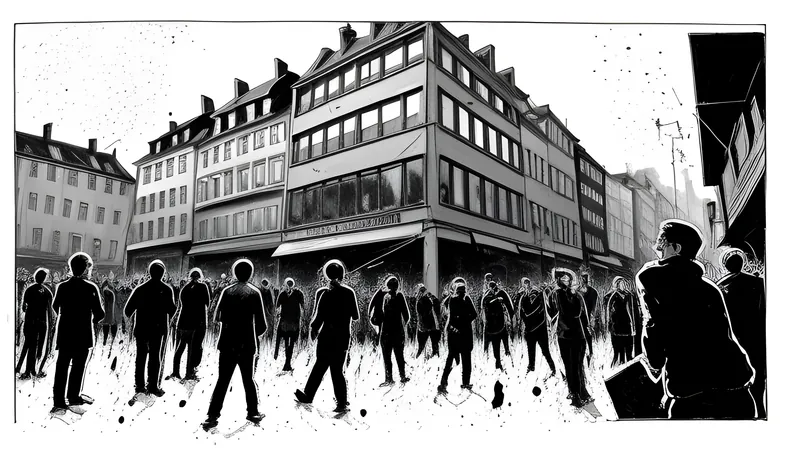
The daytime street parties are the soul of it. You walk out of your flat into a residential street that has been closed to cars, and there is a sound system on the back of a lorry, a bar improvised out of a shopfront, and a few thousand people dancing in the road with cans in hand. The music skews electronic — house, techno, the full spectrum of dance — because this grew out of club culture and never lost that DNA. It is loose, sweaty, chaotic and gloriously informal, a festival with no gates and no headliners, where the crowd in the street is the show.
Copenhagen has a deep live-music infrastructure of proper rooms — I have written love letters to VEGA and to the Christiania sweatbox Loppen — but Distortion is the annual reminder that the city’s best venue might be the street itself. For one week the careful Danish urban order dissolves, and the tarmac between the apartment blocks becomes the dancefloor.
The love, the loathing and the litter
I will be honest about the divisiveness, because pretending Distortion is universally loved would be a lie. This is a festival that runs straight through people’s neighbourhoods, and not everyone whose street becomes a dancefloor at 4pm on a Thursday is delighted about it. The complaints are real and recurring: mountains of litter, public urination, noise that goes on for hours, drunk crowds surging through residential blocks. Every year brings a fresh round of local grumbling, some of it entirely justified, and the festival’s relationship with the city has been an ongoing negotiation about how much disruption a party is allowed to impose on the people who happen to live in its path.
That tension has shaped Distortion’s whole existence. It has had to work hand in glove with the council and the police, wrestle with clean-up logistics, and periodically rethink its footprint and its funding to keep the city onside. The festival has weathered financial wobbles and format changes and talk of scaling back, and each edition arrives with a slightly renegotiated deal about what it can and cannot do. It is a genuinely difficult thing to stage — a 100,000-person party with no walls, running through people’s front gardens — and the fact that it happens at all every June is a small miracle of civic tolerance.
Europe’s accidental SXSW
There is a serious side to Distortion that gets lost in the images of drunk crowds in the road, and it is worth pulling out. The festival has long doubled as a genuine showcase for emerging music, a place where new acts — Danish and international, electronic and otherwise — play to crowds who wandered in off the street rather than paid to see them. Rolling Stone once called it Europe’s own SXSW, a comparison to the Texas festival that turned Austin into a music-industry marketplace, and the parallel is fair. Distortion is a discovery engine dressed as a street party.
That matters for a city that takes its music economy seriously. Copenhagen has a deep, well-supported live scene, and Distortion functions as its annual public face — the week the city’s club culture spills out of the venues and into the streets where anyone can stumble across it. An unsigned DJ or a new band playing a flatbed truck in Nørrebro on a Wednesday afternoon is playing to a bigger and more accidental audience than they could ever draw to a ticketed room, and some of them use exactly that exposure to build a career. The chaos has a professional undercurrent that the grumbling about litter tends to drown out.
It also makes Distortion genuinely democratic in a way most festivals only claim to be. There is no lineup poster designed to sell tickets to headliners, no VIP hierarchy governing who stands where, no gate deciding who is in. The party is free and the crowd assembles itself, which means the music that thrives at Distortion is the music that can win a street rather than a marketing budget. That is a rare and valuable thing in a festival landscape increasingly organised around who can afford the expensive wristband, and it is a big part of why the city keeps deciding the disruption is worth tolerating.
Why Copenhagen keeps saying yes
So why does the city keep allowing it? Because at its best Distortion is a genuine expression of something Copenhagen values: an open, free, democratic street culture where the party belongs to whoever shows up rather than to whoever bought the expensive ticket. In a summer of gated festivals with 200-kroner beers, there is something bracing about walking out your front door into a free party in your own neighbourhood. It is the anti-corporate festival almost by accident, because the format — mobile, free, in the road — resists the usual machinery of branding and paywalls.
For a resident, Distortion is a week you either flee or surrender to, and both are valid choices. Some Copenhageners book a holiday to escape it. Others, myself included, treat it as one of the definitive rhythms of the city’s year — the week the streets belong to the crowd, when you can wander from Nørrebro to the harbour tracing the sound systems and end up somewhere you never planned to be. It is the loose, chaotic, electronic counterweight to the harbourside metal ritual of Copenhell a couple of weeks later: two very different Copenhagen Junes, both of them the city letting its hair down.
The genius of the whole thing remains Fleurquin’s original insight, dressed up bigger every year: that a city’s nightlife does not have to stay indoors, that the party can be mobile, and that the most interesting venue in Copenhagen might be the space between its buildings. Twenty-five-odd years on from a single night in a Tivoli nightclub, that idea has scaled to six figures of people in the road, survived every financial and political wobble thrown at it, and become one of the fixed rhythms of the Danish capital’s year. Few one-night parties leave a mark that big.
Distortion is not for everyone, and it does not pretend to be. It is loud, it is messy, it inconveniences thousands of people, and it is one of the truest things Copenhagen does. Every June the streets become the venue, and the city, grumbling and dancing in roughly equal measure, lets them.
Related Content