D-A-D: The Danish Cowboys Who Nearly Conquered America
How a Copenhagen band called Disneyland After Dark rode the western myth to the edge of US stardom — and why the door shut
Contents
There is a photograph in every Danish rock fan’s memory of four men in cowboy hats who have plainly never worked a ranch in their lives, grinning like they got away with something. They did. For roughly eighteen months at the tail end of the 1980s, a Copenhagen band that started life with the gloriously stupid name Disneyland After Dark had a Warner Bros. contract, a song climbing the American rock charts, and a genuine, credible run at the thing every European band dreams about and almost none of them get: breaking the United States. They did not break it. But how close they came, and precisely how the door swung shut, is one of the best near-miss stories the Nordic scene has to offer — and the reason D-A-D remain a national institution at home forty-odd years on.
The best band name Disney ever killed
Start with the name, because the name tells you everything about the humour. In 1982, four kids in Copenhagen formed a band and called it Disneyland After Dark. The idea, credited to bassist Stig Pedersen, was that when the lights go out in Disneyland, anything can happen — a perfect adolescent image, wholesome and menacing at once, the Magic Kingdom with the safety off. It is a great name. It is exactly the kind of great name that a certain Californian entertainment corporation employs a legal department to extinguish.
The Walt Disney Company noticed. And here is a detail that gets flattened in the retellings: there was never actually a lawsuit filed, no dramatic day in court. What there was — which was quite enough — was the credible threat of one. Disney had a long, well-documented habit of making good on such threats against anyone who used the name without permission, and the practical effect was total. No record company outside Denmark would touch a group called Disneyland After Dark, because signing them meant signing up for a fight with Disney’s lawyers. So for the 1989 international release the band abbreviated to D-A-D, and the story has passed into rock folklore as the time Disney sued the Danish cowboys. They didn’t sue. They didn’t have to. The threat did the work, which is arguably more Disney than a lawsuit would have been.
The band kept fiddling with the punctuation for years afterward — it became D:A:D in 1995 to hammer home that these were initials, then settled to the tidier, more search-engine-friendly D-A-D around 2000. Small thing, but it tells you they were paying attention to how a name travels, which for a band with international ambitions is not nothing.
Cowboys from a country with no cowboys
The look was the hook. D-A-D dressed western — hats, boots, a spaghetti-Western squint — and leaned into a dust-and-desert Americana that was completely absurd coming from a band whose home city is flat, cold, and about as far from Monument Valley as a place can get. That absurdity was the point. This was Denmark doing America the way America does itself in the movies: bigger, dumber, funnier, and knowing exactly how silly it looked. The songs matched it — muscular, hooky hard rock with a comic-book grin, closer to the widescreen swagger of a good B-movie than to anything self-serious.
Frontman Jesper Binzer had the growl and the presence; his younger brother Jacob Binzer, who joined in 1984, handled lead guitar. Stig Pedersen anchored the low end and, crucially, the visual madness. Peter Lundholm Jensen kept the drum stool from 1984 until 1999, when Laust Sonne took over. The line-up has been remarkably, almost boringly stable for a rock band — which is part of why they’ve lasted. Nobody left in a huff. They just kept playing.
The western thing worked on two levels, and the smarter of the two is why the band matters. On the surface it’s a costume. Underneath, it’s a very European joke about the American myth — the same fascination that runs through so much Danish loud music, that sense of a small northern country looking across the Atlantic at the sheer noise and scale of the place and deciding to build its own scaled-up version. It’s the through-line you can trace from the corpse-paint theatre of King Diamond to the rockabilly stomp of Volbeat a generation later. Denmark keeps producing bands that love America too much to take it entirely seriously, and D-A-D wrote the template. If you want the wider argument about how a country of under six million became a loud-music exporter well above its weight, I’ve made the case in Little Country, Loud Export; D-A-D are exhibit A.
No fuel, one shot
The record that nearly did it was No Fuel Left for the Pilgrims. It came out in Denmark on 3 March 1989 — still under the Disneyland After Dark banner on that first home pressing, via Medley Records — and then went worldwide on 8 September 1989 through Warner Bros., now as D-A-D. A major American label, a proper international push, the full machine. For a Danish rock band in 1989 this was rarefied air. Denmark did not export rock bands to America. It still barely does.
And for a moment it worked. The lead single, “Sleeping My Day Away,” is a proper song — a lazy, swaggering, sing-along thing with a chorus built to travel — and travel it did. It reached number 23 on Billboard’s Album Rock Tracks chart, the format that actually mattered for a hard-rock band trying to get onto American radio. The album itself climbed to number 116 on the Billboard 200. The single dented the UK chart at number 87 and the band picked up real traction in Australia too. Over its life No Fuel Left for the Pilgrims has sold something like 600,000 copies worldwide, roughly 275,000 of them at home in Denmark and around 100,000 in the United States.
Read those American numbers coldly and they are the numbers of a band that got a foot in the door. A hundred thousand US copies and a top-30 rock-radio single fall short of a breakthrough, yet they are exactly the launchpad for one — the position from which the next record, with touring and momentum behind it, is supposed to be the one that connects. Plenty of bands built careers off less. The support slots, the radio play, the buzz: for a window there, D-A-D were a name American rock fans were starting to learn.
What changed the weather
The next record did not connect, and the honest reason is partly D-A-D and mostly the calendar.
No Fuel Left for the Pilgrims landed in 1989. Within two years the entire American rock market that had welcomed it was gone. When Nirvana’s Nevermind broke wide in the autumn of 1991, the melodic, big-chorus, good-time hard rock that D-A-D traded in — the whole radio format that “Sleeping My Day Away” had climbed — became commercially radioactive almost overnight. Grunge didn’t just add new bands to the American diet; it made the previous decade’s sound feel instantly, terminally uncool. Labels dropped hair-adjacent acts by the dozen. A Danish band doing widescreen, hats-on, unashamedly fun hard rock was suddenly on exactly the wrong side of the most abrupt taste shift American rock has ever undergone.
You can argue about whether D-A-D would have broken America even without grunge — plenty of bands with US labels and a chart single never take the final step, and the western-comic angle that made them irresistible in Europe might always have read as a novelty across the Atlantic. That’s a fair criticism to keep on the table. But the timing removed the argument. The follow-up, Riskin’ It All in 1991, arrived just as the ground opened up. The American window that had cracked open in 1989 shut, and it shut on a lot of better-connected bands than D-A-D too. They were one of many caught on the wrong tide. They just had further to fall, because they’d climbed higher than a Danish band had any right to.
Here is the part that matters, and it’s to the band’s enormous credit: they didn’t chase it. There was no grim reinvention, no flannel-shirt rebrand, no decade spent trying to claw back an American market that had made its feelings clear. They went home and got on with it.
National treasure, two-string bass
Because the other half of the D-A-D story is what happened after America said no — which is that Denmark said yes, forever.
At home they are not a nostalgia act; they are an institution. Long after the US window closed, D-A-D albums kept going straight to the top of the Danish charts — Soft Dogs in 2002, Scare Yourself in 2005, Monster Philosophy in 2008, all number ones — a run of home dominance that most bands with far bigger international profiles would trade a limb for. They headline the big Danish stages, pull enormous home crowds, and have kept the same core four-piece playing for four decades with the sort of unfussy consistency that turns a band into part of the furniture of a country’s culture. When Danes talk about their own rock heritage, D-A-D are simply assumed, the way the British assume Status Quo or the Australians assume Cold Chisel.
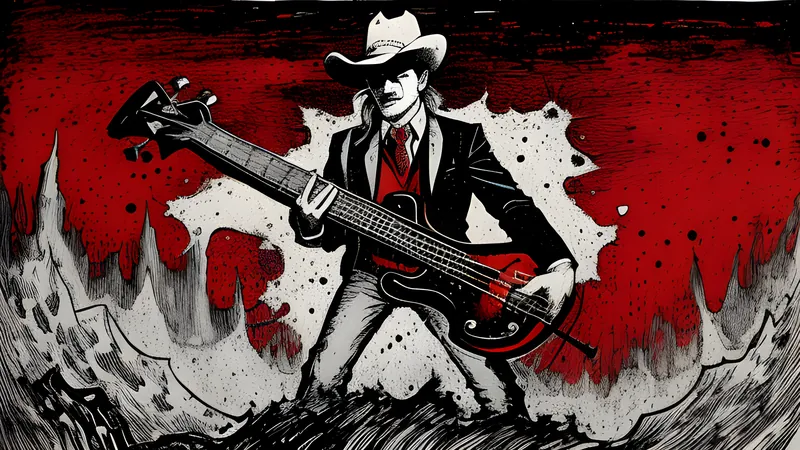
And then there is Stig Pedersen, who deserves his own paragraph and probably his own museum wing. Somewhere along the way the bassist decided that a normal bass guitar was insufficiently ridiculous and began playing almost exclusively two-stringed instruments — you do not need four strings if you only ever play the bottom two, and Pedersen turned that logic into a lifelong bit. The basses themselves became props: extravagant, cartoonish custom shapes, rockets and horns and, at one point, a bass built to look like a giant iPhone. It is showmanship as engineering, the low-end equivalent of a stadium pyro rig, and it fits the band’s whole comic-monumental sensibility exactly. Everything about D-A-D is slightly too big and entirely on purpose. The bass with two strings and a fuselage is the thesis statement.
The verdict
Was it a failure? Only if the American market is the only scoreboard that counts, and it isn’t. D-A-D got closer to breaking the US than almost any Danish rock band before or since, did it on their own absurd terms, in cowboy hats, with a name a global corporation had tried to strangle — and when the weather turned they had the sense to go home rather than humiliate themselves chasing a moment that was over.
The near-miss is the interesting part precisely because it was so near. A top-30 American rock-radio hit and a hundred thousand US sales in 1989 is a foot wedged firmly in a door that then slammed for reasons that had nothing to do with the quality of the band. History handed them lousy timing and a great story, and they’ve spent thirty-odd years being one of the most beloved live acts in their own country, which is a better ending than most of the bands who did break America in 1989 got to enjoy. They are the country’s answer to the American dream, played back louder and funnier — the same national streak that later powered Denmark’s biggest export onto the world’s stages. And if you ever catch them on a big Danish night, look at the bass. Two strings, shaped like a rocket. That’s a band that knows exactly what it is, and stopped apologising for it a very long time ago.
Related Content