Crowd Surfing: The Unwritten Rules
How to travel a room on a thousand hands without hurting anyone, yourself included
Contents
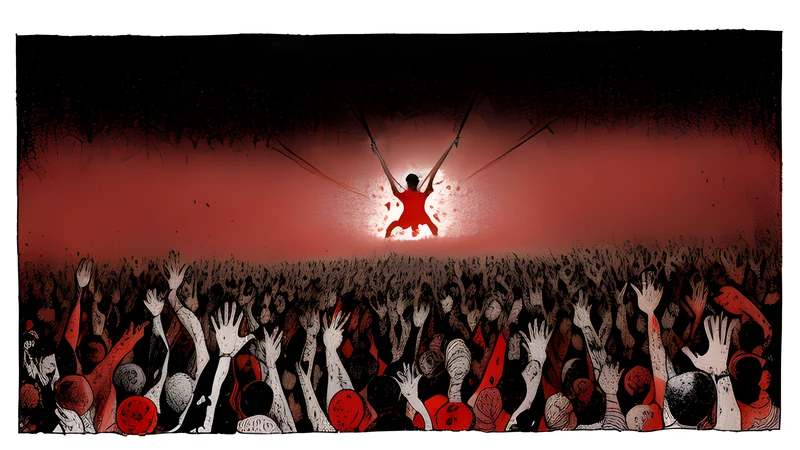
There is a specific sound a crowd makes when someone launches into a surf — a ripple of raised arms and a collective adjustment as several hundred people silently agree to become, for the next ten seconds, a moving surface. A body appears above the heads at the back, lying flat, and begins to travel toward the stage on a thousand hands, carried forward hand over hand until it reaches the barrier and is lowered by the security crew into the pit at the front. It looks like the most reckless thing in the room, a person surrendering their entire body to strangers, and it works only because those strangers are following a code that nobody ever prints and everybody somehow knows.
I have surfed and I have done far more of the carrying, in Danish rooms and at festivals across Europe, and crowd surfing is the crowd ritual that depends most completely on trust. A wall of death is over in a second; a circle pit keeps you on your own feet. A surf puts your skull and your spine entirely in the hands of people you have never met, moving over a hard floor you cannot see, and the fact that this is one of the safer things you can do at a gig — when everyone plays their part — is a genuine testament to how well the unwritten rules hold. So let me write them down, because they are worth stating plainly.
The rules for the rider
If you are the one surfing, the whole burden of not getting hurt, and of not hurting anyone else, rests on a few simple disciplines. You go up flat and you stay flat. A rigid, horizontal body distributes your weight across the most hands and is the easiest thing for a crowd to carry; a thrashing, upright, panicking body is a nightmare that collapses through the surface and takes people down with it. The counter-intuitive truth of surfing is that the calmer and more still you are, the safer you are. Trust the hands and lie back.
You travel feet-first toward the barrier, and you keep your boots under control. The single most common injury in crowd surfing is a heel or a boot to someone’s face, and the rider who kicks and swings is a menace to everyone underneath. Point your feet toward the stage, keep your legs still, and remember that the faces below you are the faces of the people keeping you alive. You exit at the barrier and you exit fast. When you reach the front, the security crew will grab you and lower you — go with them, get your feet down, and clear the area quickly so the next surfer and the crowd behind can keep moving. Lingering, climbing back up, or trying to get to the stage turns a courtesy into a problem.
And the rule that comes before all of them: you read whether the room can even take you. Crowd surfing needs a dense, deep, willing crowd and a proper barrier with a crew behind it. Launch into a thin crowd, or near the edge where the hands run out, and you go straight to the floor. A big person surfing over a light crowd is asking too much of it. Judgement about whether to go up at all is the first and most important rule.
The rules for the crowd
If you are one of the hundreds doing the carrying, your job is just as codified. You support, and you keep them moving toward the barrier. A surfer is meant to travel; a crowd that stalls, or that pushes a rider sideways or backward, strands them over open floor. The collective task is to pass the body steadily forward, hand over hand, until it reaches the front and the crew. You protect the head above everything else. If a surfer starts to go down, the priority is to get hands under the shoulders and skull and slow the fall, because a head hitting a hard floor is the one genuinely serious risk in the whole ritual. Everyone underneath is, for those few seconds, a spotter.
You never drop someone on purpose, and you catch the ones who fall. The crowd’s contract with a surfer is total: you took them on, you see them safely to the front. And when a surf collapses anyway, as they sometimes do, the same reflex that governs every pit ritual takes over — the people nearest stop, form a barrier, and get the fallen rider back on their feet before the crush can reach them. It is the identical instinct that keeps the wall of death and the circle pit safe, applied to a body that arrived from above.
The rule too often broken
There is one rule that needs stating loudly because it is broken far too often, and it concerns consent and hands. Carrying a surfer means supporting them, and touching anything else is assault. Women who crowd surf are groped with a frequency that is genuinely shameful, hands going where they have absolutely no business going while a person is at their most vulnerable and least able to defend themselves. This is not a grey area and it is not part of the fun. The etiquette of the crowd is explicit: you hold the surfer up, you keep your hands to their back and shoulders and legs, and anyone using the ritual as cover to grope is violating the single most important trust the crowd runs on.
The good news is that the crowd can and does police this, and the culture has visibly hardened against it over the years — riders called out, offenders shoved away, a growing intolerance for the creeps who exploit the surf. That collective enforcement is the same self-policing that makes every pit ritual work, turned toward the one behaviour that would otherwise poison it. A scene that cannot keep its surfers safe from wandering hands has failed at the most basic level, and the Danish crowds I know take that duty seriously.
The barrier, the crew and the photographers
Crowd surfing is unique among the rituals in that it involves professionals. The surf ends at the barrier, where the security crew — the people working the front of stage — catch each rider and lower them into the gap between the barrier and the stage before sending them back around the side. A good barrier crew is the unsung hero of any big show, catching bodies for hours, passing down water, watching the front row for the person going pale in the crush. The whole ritual depends on that crew being present and competent, which is precisely why crowd surfing belongs to rooms built for it.
Those rooms are the larger ones. You need a barrier, a crew, and a crowd deep enough to carry a body, which makes surfing a big-venue and festival phenomenon — the cavernous grandeur of Den Grå Hal or the fields of Copenhell rather than a tiny room with no barrier and nowhere for a surfer to land. That front-of-stage zone is also where the photographers work, in the pit between the barrier and the band for the first three songs, and the etiquette of that space is its own subject I’ve covered in three songs, no flash. The barrier is the busiest, most carefully managed few metres in any venue.
Surfing, stage diving and the small-room cousin
It helps to separate two things that outsiders lump together. Crowd surfing is being carried across a crowd toward the barrier; stage diving is launching yourself off the stage into the crowd, which is how a surf often begins at a smaller show where there is no barrier and no crew to lift you up from the back. The two share a physics and an etiquette, but the stage dive puts more of the risk on the crowd, which has a fraction of a second to react to a body coming off the monitors. The unwritten rule for the diver is the mirror of the rule for the surfer: read whether the crowd is ready and dense enough to catch you before you leave your feet, because a dive into a crowd that has turned away or thinned out ends on the floor every time.
Small rooms change the whole calculation. Without a barrier, the surfer has nowhere to be safely deposited, and the ritual either becomes a quick loop back into the crowd or does not happen at all. That is why the tightest, sweatiest clubs tend to favour stage diving over sustained surfing, the diver going up and coming straight back down rather than travelling any distance. The presence or absence of a barrier is the single feature that most shapes how the front of a crowd behaves, quietly dictating which rituals a room can host. Learn to read it on the way in and you know what kind of night the front rows are in for.
There is a longer history here too, running back through decades of hardcore and punk shows where stage diving was the default mode of audience participation and the boundary between stage and floor was treated as a suggestion. Crowd surfing at festival scale is the descendant of that older, rowdier tradition, formalised and made safer by the barrier and the professional crew, but carrying the same basic impulse to collapse the distance between the band and the people watching.
Why we hand ourselves over
Step back and crowd surfing is the strangest thing we do at a gig, stranger even than sprinting at each other, because it is a total surrender. You give your body to a crowd and let it decide your path, your speed and your safe arrival, with no ability to protect yourself once you are up there. People do it for the same reason they do any of it — the euphoria of a shared physical moment, the specific thrill of being carried on the collective goodwill of a room, a few seconds of flight above a crowd that has agreed, silently and instantly, to keep you whole. It only makes sense once you understand what the mosh pit is actually for as a machine for turning strangers into a temporary community.
That surrender is the point, and the unwritten rules are what make the surrender survivable. Lie flat, feet to the front, hands to yourself, protect the head, catch the fallen, drop nobody, and keep the creeps out — a code transmitted purely by example, gig after gig, from the people who have been carried to the people learning to carry. Get it right and the most reckless-looking act in the building becomes a small proof of how much strangers will do for each other when the lights go down. You go up, and a room full of people you will never meet decides, together, to bring you home.
Related Content