Converge: Hardcore's Most Violent Art
How four men from Massachusetts turned chaos into craft, made the defining heavy record of its decade, and never once coasted
Contents
Put on the first thirty seconds of a Converge record and it sounds like a car crash you can’t look away from — guitars folding in on themselves, a drummer playing three tempos at once, a voice shredded past language. Stay with it and you realise none of it is an accident. Every jagged edge is placed.
Salem, 1990
Converge formed in Salem, Massachusetts, in 1990, built around two teenagers who are still the band’s core three and a half decades later: vocalist Jacob Bannon and guitarist Kurt Ballou. They came up through the New England hardcore scene, played the VFW halls and basements, and spent the 1990s slowly becoming something the hardcore rulebook hadn’t accounted for.
The classic line-up locked into place around the recording of their fourth album in 2001. Guitarist Aaron Dalbec left, bassist Nate Newton and drummer Ben Koller came in, and the band became the four-piece it has been ever since. That stability matters. Converge are one of those rare heavy bands whose central membership simply never churns, and you can hear the benefit in how tightly they interlock — this is music that only works because four people have been listening to each other for twenty-five years.
Each member is a scene in himself. Ballou runs GodCity Studio and has produced a staggering slice of modern heavy music, so Converge’s own records carry the same sonic fingerprint as half the bands they influenced. Bannon is a visual artist who runs the Deathwish Inc label and designs the band’s artwork, which is why a Converge record looks as distinctive as it sounds. Koller and Newton play in a shelf of other projects. The band is a hub, and the spokes reach a long way into the underground.
Jane Doe
Then there is Jane Doe, released in 2001, the album that made everything before it feel like a warm-up. It is a break-up record disguised as an extremity contest, Bannon’s lyrics circling loss and obsession while the band behind him plays with a violence that has an emotional logic to it. The famous cover — a woman’s face, Bannon’s own drawing — is one of the most recognised images in heavy music, tattooed on thousands of forearms.
The record’s reputation has only grown. Terrorizer named it the best album of 2001. Sputnikmusic later called it the best album of the decade. Rolling Stone placed it 61st on its list of the greatest metal albums ever made. Those are not the accolades a genre hands to a difficult, abrasive hardcore album by default; they are what happens when a difficult, abrasive album turns out to be a genuine masterpiece that people keep returning to.
What Jane Doe proved is the thing this whole piece is about. The most extreme heavy music can also be the most controlled. Chaos and craft are usually treated as opposites, and Converge spent a career collapsing the distinction — the sound is savage precisely because every savage moment is deliberate.
Mathcore, and the violence as design
The lazy shorthand for what Converge do is “mathcore” — hardcore played with the time signatures and structural whiplash of something far more technical. It is a useful label and an incomplete one. The band’s real innovation was proving that a song could sound like it was flying apart while every player knew exactly where the seams were.
Listen to how a Converge song moves. A blast of grinding hardcore snaps into a passage of almost jazz-like drumming, drops into a riff heavy enough to buckle a stage, then resolves somewhere you didn’t see coming. It should be a mess. It is instead one of the most precisely engineered things in heavy music, and that precision is what separates them from the thousand bands who copied the surface aggression and missed the architecture underneath.
The catalogue after Jane Doe never coasted, which is the other remarkable thing. You Fail Me in 2004, No Heroes in 2006, Axe to Fall in 2009, All We Love We Leave Behind in 2012, The Dusk in Us in 2017 — each one a real record with its own weather, none of them a lap of honour. In 2021 they went somewhere else entirely with Bloodmoon: I, a collaborative project pulling in Chelsea Wolfe and other voices, trading brute speed for a heavier, slower, more cinematic darkness. A band thirty years deep does not usually reinvent its own palette that convincingly.
Live: controlled demolition
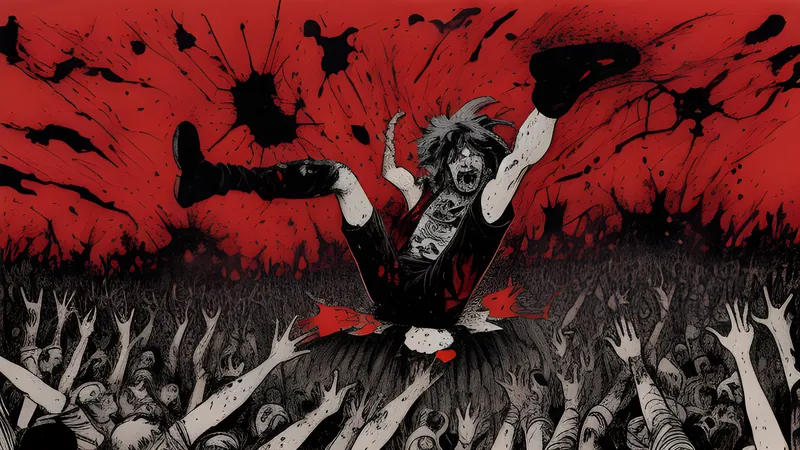
On a stage Converge are a small band making an enormous, exact noise. There is no pyro, no theatre, no upside-down drum riser — just four men and a wall of controlled demolition. Ballou hunched over his guitar, Koller a blur, Newton anchoring the low end, Bannon prowling the front with a microphone cord wrapped round his fist.
The pit at a Converge show is its own weather system, and the band’s music is built to trigger it — the sudden hairpin turns, the breakdowns that arrive a half-second before you brace for them. If you want the theory of why a crowd does that to itself, the mosh pit has a genuine social logic, and Converge songs are engineered to exploit every part of it, including the wall of death when the tempo finally slams down. The chaos on the floor is the mirror image of the chaos on the stage, and both are more organised than they look.
Their relationship with the European heavy circuit runs deep. Converge have long been fixtures of the festivals where extremity is treated as art rather than novelty — the kind of programming Roadburn built its whole reputation on, where a band this uncompromising headlines rather than opens. Watching an American hardcore band become a curatorial cornerstone of European heavy culture tells you how far the influence spread from those Salem basements.
The art around the noise
The other thing that separates Converge from the pack is how much of a total artistic project the band is. Bannon’s visual work is inseparable from the music. His covers, layouts and typography give the records a unified, instantly recognisable identity, and through Deathwish Inc — the label he co-founded — that aesthetic sensibility rippled out across a whole generation of heavy bands. A Deathwish release looks like a Deathwish release, and a lot of that grammar traces back to Bannon’s hand.
Ballou’s studio does the same work on the sound side. GodCity, his studio in Salem, became a pilgrimage site for heavy bands who wanted a specific kind of raw, muscular, honest recording — no digital gloss, everything caught with the grit intact. When you notice that a large number of the best metallic-hardcore records of the last two decades share a certain sonic character, that is frequently Ballou’s doing. The band’s influence therefore travels on two tracks at once: the songs themselves, and the records Ballou shaped for everyone else.
That is a rare thing in heavy music, where the labour is often split up — someone writes, someone else records, a label handles the look. Converge kept nearly all of it in-house, and the coherence shows. Every part of the package, from the sleeve art to the mix to the lyric sheet, points in the same direction. It is closer to how you’d think about a serious art collective than a hardcore band, and it is a large part of why the work has aged so well while so much of the surrounding scene curdled into cliché.
Why they matter
Converge’s importance is hard to overstate without overstating it, so let me keep it plain. A vast amount of heavy music made since 2001 — metalcore, the more technical strains of hardcore, the whole sound of a certain kind of emotional extremity — runs back through Jane Doe and the band that made it. Ballou’s production work spread the DNA even further than the songs did.
The deeper lesson is the one about craft. Converge took the most confrontational, least commercial corner of heavy music and treated it with the seriousness of an art form — the artwork, the labels, the studio, the refusal to repeat themselves. Thirty-five years in, they remain the proof that violence and discipline are the same gesture when you do it properly. The car crash was composed all along.
It is worth sitting with how unlikely that outcome is. Extreme music tends to burn its practitioners out fast; the bands that survive usually do so by softening, slowing, or leaning into nostalgia. Converge did none of those things. They stayed heavy, stayed strange, kept the same four men bashing it out, and let the reputation catch up to the work rather than chasing it. The result is a catalogue with almost no weak link and a live show that still empties the floor into motion the second the first note lands. For a band that started as teenagers in a Massachusetts basement in 1990, that is about as complete a career as heavy music offers — and they are, at time of writing, still going.