Clutch: The Best Bar Band That Also Sells Out Theatres
Four men from Maryland who turned relentless touring and a preacher's cadence into one of rock's most durable live franchises
Contents
There is a category of band that never troubles the charts, never has the crossover single, never gets the magazine cover, and yet can roll into almost any city on almost any continent and fill a room of a thousand people who know every word. Clutch, four men from Germantown, Maryland, are the reigning champions of that category. They have been at it since 1991 with the same four musicians, no reunions required because they never broke up, and they have quietly become the closest thing modern rock has to a guaranteed good night out.
Four blokes and a very long road
The line-up is the first remarkable thing about them, because there is only one line-up. Neil Fallon on vocals, Tim Sult on guitar, Dan Maines on bass and Jean-Paul Gaster on drums have played together for more than three decades without a single acrimonious exit, which in rock terms is roughly as common as a comet. They formed as teenagers in the Maryland suburbs, came up through the American hardcore and post-hardcore circuit of the early 1990s, and slowly sanded their sound down into something bluesier, heavier and stranger than the punk they started with.
What they built instead of a hit was a touring operation. Clutch tour the way other bands breathe, working a circuit of theatres and mid-sized halls across the United States and Europe year after year, refining a live show that runs on groove and precision rather than pyrotechnics. You go to a Clutch gig and there are no video screens the size of buildings, no costume changes, no confetti cannons. There are four men in ordinary clothes playing extraordinarily tight rock music, and it turns out that is enough to sustain a career longer than most marriages.
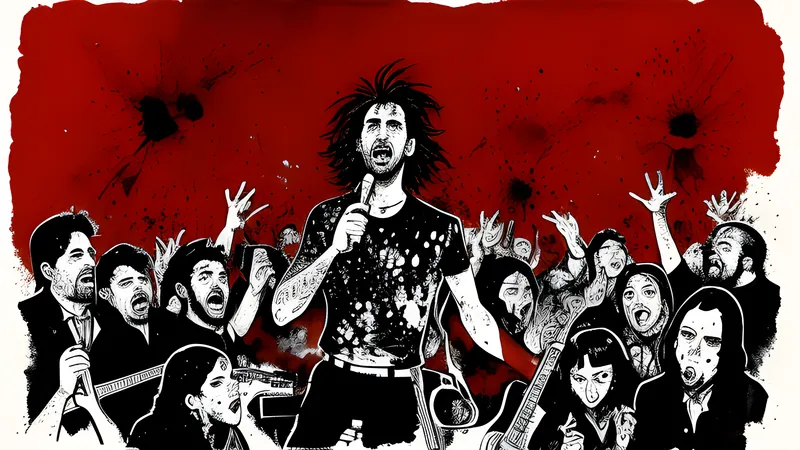
I have watched this machine at work in a Copenhagen club and it is a genuinely strange thing to witness sober. The band walk on looking like they have come to fix your boiler. Then Gaster counts it in, the riff lands, and the room converts instantly into a swaying, fist-pumping congregation. That word, congregation, keeps coming up with Clutch, and it is not an accident.
Neil Fallon, the preacher who reads too much
The engine of the whole thing is Fallon, one of the most distinctive frontmen in rock and one of the least conventionally rock-star. He does not have the range of a metal wailer or the beauty of a pop voice. What he has is cadence, a rolling, sermonising, half-shouted delivery that sounds like a tent-revival preacher who spent the week in a library and came back with opinions about Nikola Tesla, the Book of Revelation, riverboat gamblers and mustard.
Fallon’s lyrics are the band’s secret weapon and the reason their fans are so devoted. They are dense, funny, allusive, stuffed with American folklore and pulp mythology and phrases that lodge in your head for years. He writes about electric worry-hats and blind kings and roadside diners with the glee of a man who genuinely loves words, and he sells every line with a conviction that turns nonsense into gospel. Half the crowd could not tell you what a given song is about and all of them will bellow the chorus anyway, because the feeling is unmistakable even when the plot is not.
That preacher energy is why Clutch translate so well live. A lot of clever studio bands wilt on stage. Fallon does the reverse. He plants himself at the microphone, throws his arms wide, and conducts a room like a man who has found his true vocation, which is standing in front of loud people and testifying about very odd subjects. It is one of the great sights in touring rock, and it costs the price of a club ticket.
The catalogue nobody skips
Clutch’s discography is deep and, unusually, consistent. Their self-titled 1995 album gave the underground the grinding stomp of “Big News” and marked them out as something heavier than their peers. Then came a slow, patient climb: Blast Tyrant in 2004 is the record a lot of fans point newcomers toward, tighter and more song-focused than the sprawl that came before, and Robot Hive/Exodus the year after leaned into the blues and the Hammond organ. Earth Rocker in 2013 stripped the sound back to lean, fast, muscular rock and became a career high, the album that firmly moved them up from clubs into theatres.
They have kept the standard remarkably level ever since, through Psychic Warfare in 2015, Book of Bad Decisions in 2018 and Sunrise on Slaughter Beach in 2022. Crucially, they own the operation. Clutch run their own label, Weathermaker Music, founded in 2008, which means they answer to nobody about how often they release, how hard they tour or what a song is allowed to be about. That independence is the quiet foundation under everything else, and it is why they have aged into elder statesmen without ever softening or selling the farm.
The Hammond organ and the blues underneath
One thing that separates Clutch from the heavy bands they came up alongside is the blues. Scratch the surface of almost any Clutch song and you find twelve-bar bones, a swing in the rhythm section, a debt to the John Lee Hooker and Howlin’ Wolf end of American music as much as to Black Sabbath. For a stretch in the mid-2000s they leaned right into it, bringing in Hammond organ and letting Gaster’s drumming loosen into something that grooved rather than pummelled. Robot Hive/Exodus in 2005 is the fullest expression of that phase, a record where the band sound like a heavy blues revue that happens to have wandered out of a Maryland basement.
That blues foundation is the secret to their longevity, because the blues is a form built for ageing. A twenty-two-year-old can play thrash and a fifty-year-old can play the blues, and Clutch, who are now firmly in the second category, have a musical language that suits men who have been playing together for three decades. They do not have to sprint to stay relevant. They can dig in, sit in the pocket, and let the groove do the work, which is exactly what the best old bar bands have always done. The difference is that Clutch’s bar happens to hold a thousand people.
Gaster deserves singling out here, because a groove band lives or dies on its drummer, and he is one of the most tasteful in heavy music. He plays with a jazz drummer’s sense of space, leaving gaps where a lesser player would fill, and it is that restraint that gives the riffs room to swing rather than merely stomp. Sult’s guitar sits in those gaps, economical and bluesy, and Maines anchors the low end without showing off. It is a rhythm section built for the long haul, and it shows every night.
Where they sit in the loud family tree
Clutch are hard to file, which is part of the appeal. They are too heavy for classic-rock radio, too bluesy and witty for metal purists, too groove-driven to be punk any more. What they share with the best festival acts is a physical, communal quality: their songs are built to be moved to, and a Clutch pit is a friendly, rolling, mid-tempo affair rather than the churn you get at the sharper end of a bill. If you want to understand what a mosh pit is actually for, a Clutch crowd is a gentle place to start, because the aggression has been swapped out for pure momentum.
They belong to the same touring ecosystem as the doom and stoner acts who congregate at pilgrimages like Roadburn in the Netherlands, where the riff is holy and the band who can lock a groove for six minutes is king. Clutch have long been beloved of that world without ever quite being of it, which suits them. They are a rock band, plainly and proudly, and they have spent thirty-odd years proving that plain and proud, done with total commitment, outlasts almost everything flashier.
Their fanbase reflects that. A Clutch crowd skews toward the lifers, people who have followed the band across a decade or two of tours and treat each new record as another chapter rather than a comeback. It is one of the more good-natured audiences in heavy rock, drawn from metalheads, punks, blues obsessives and ordinary rock fans who found the band by word of mouth and never left. That breadth is a direct consequence of the music’s refusal to sit in one box, and it means Clutch can share a bill with almost anyone, from a doom pilgrimage to a mainstream rock festival, and win the room either way.
The lesson of Clutch, if you want one, is that durability is its own kind of stardom. They chose the road over the radio, kept the same four men in the van, wrote songs weird enough to stay interesting and tight enough to never bore, and turned up, and turned up, and turned up. When a lot of their flashier contemporaries have long since fragmented into nostalgia reunion tours, Clutch simply announce more dates. Catch them in a theatre near you. They will be there. They are always there.
Related Content