Cheese Rolling at Cooper's Hill: Chasing a Wheel Down a Cliff
A near-vertical Gloucestershire slope, a nine-pound Double Gloucester, and the maddest folk sport in Britain
Contents
Once a year on a hillside in Gloucestershire, a man rolls a wheel of cheese off the top of a near-vertical slope, and a crowd of people throw themselves down after it. The cheese wins. It almost always wins. The cheese rolling at Cooper’s Hill is the most reckless folk event in Britain, and I say that with enormous affection.
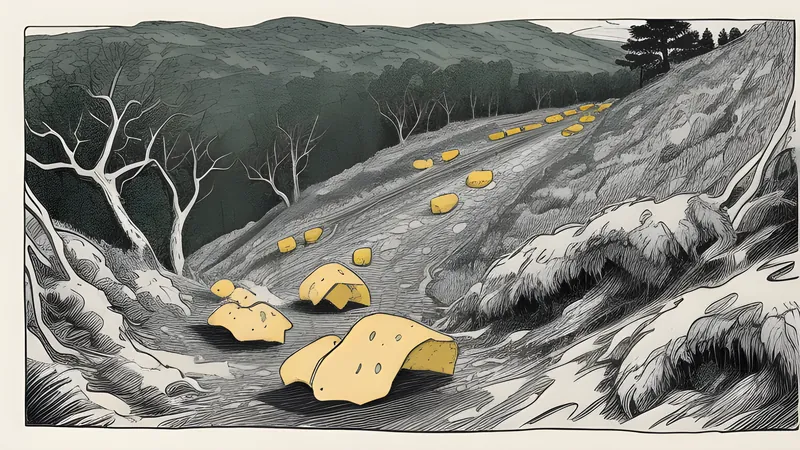
Cooper’s Hill sits near the village of Brockworth, outside Gloucester. It is a grassy slope of roughly 26 degrees at the shallow end and something close to a 1-in-2 gradient at the worst of it — steep enough that from the bottom, looking up, the runners at the top appear to be standing on a wall. Every Spring Bank Holiday, at the tail end of May, people gather here to chase a 7-to-9-pound wheel of Double Gloucester down that wall, and the winner keeps the cheese.
I write from Copenhagen, and I have not run it — this is a cultural read, a Dane’s fascination from a safe distance across the North Sea. But British daftness has a specific flavour I have come to love through years of festival travel, and Cooper’s Hill is its purest, most alarming expression. Finland gives the world absurd competitions played with deadpan technique. Wales gives you a cold bog to swim. Gloucestershire gives you a cliff and a dairy product and says: after it, then.
The physics of a fleeing cheese
The mechanics are brutally simple, which is exactly why they are so dangerous. A master of ceremonies at the top gives a four-count. On “three” the cheese is released; on “four” the runners go. The Double Gloucester, a hard cheese made in a traditional circular shape and here bound in a wooden casing for durability, gets a one-second head start and never surrenders it. On that gradient a rolling wheel accelerates hard, bouncing and skittering, and it has been clocked at speeds people put as high as 70 to 80 miles per hour by the time it reaches the bottom.
No human catches it. That is the first thing to understand. The “race” is not really a chase at all — the cheese is uncatchable — so the actual competition is between the humans. The winner is simply the first person to cross the line at the bottom of the hill, which means the event is less a foot race and more a controlled avalanche of bodies. Nobody runs down Cooper’s Hill in any meaningful sense. You commit to the top, gravity takes you, and from there it is tumbling, cartwheeling, sliding, and a great deal of hope. The people who “win” are frequently the ones who fell in the most efficient direction.
That is the whole grim comedy of it. You cannot stay upright on that slope at that speed. The successful competitor is the one who converts an uncontrolled fall into forward progress and reaches the flat first, ideally still conscious.
Injuries are the honest part of the story
I will not invent a scene for you. I was not there, and Encore does not fabricate specific incidents. What the public record makes plain, year after year, is that people get hurt at Cooper’s Hill, and that this is not a scandal so much as an accepted feature of the thing. Sprains, dislocations, broken bones, concussions — the medical presence at the bottom of the hill is real and it stays busy. Local ambulance services and volunteer rescue teams have long treated the event as a known quantity, patching up the tumblers and sending most of them home sore but grinning.
This is where cheese rolling parts company with the gentler absurd sports of Europe. Swimming a Welsh peat trench in flippers is cold and undignified and broadly safe. Carrying a partner through an obstacle course at the Wife-Carrying World Championships in Sonkajärvi risks a bruise and a dropped spouse. Cooper’s Hill risks a hospital. The danger is not incidental to the event; it is the reason the crowd holds its breath, and it is the reason the winners’ names carry a genuine, hard-won glory.
How old is the madness?
Nobody can tell you for certain when people first started rolling cheese down Cooper’s Hill, which is part of the charm. The event is genuinely old — records and local memory push it back at least a couple of centuries, and it was already a going concern in the early 1800s. Its true origins are lost, and into that gap folklore has poured the usual competing theories. One holds that it began as a way of asserting common grazing rights on the hill. Another traces it to older pagan fertility or midsummer rites, with the rolling wheel of cheese as a stand-in for the sun rolling across the sky, bringing the year’s harvest with it. A third, more prosaic, has it simply as a village wake — a seasonal knees-up that acquired a cheese and a hill and never looked back.
Which of these is true, if any, matters less than the fact that the custom has outlived every explanation for it. People stopped needing whatever reason first put a cheese on that hill, and they kept rolling it anyway, because it had become the thing you do at Brockworth on the Spring Bank Holiday. That is how the strongest traditions work. They shed their original purpose and survive on pure momentum, carried forward by nothing more than the shared conviction that stopping would be unthinkable. The Double Gloucester connection is fitting, mind — this is Gloucestershire, the cheese is the county’s own, and rolling the local product down the local hill has a rightness to it that no committee could have designed.
Nobody is officially in charge
Here is the detail that makes Cooper’s Hill so peculiarly British: for years now, the event has had no official organising body. It is, in the strict sense, unsanctioned. There was a point in the last decade or so when the crowds swelled beyond what any small committee could safely manage, insurers and authorities took a dim view of the whole liability nightmare, and the formal organisation quietly stepped back rather than be held responsible for the inevitable.
And the event simply did not stop. It carried on as pure folk custom — people turning up on the Bank Holiday because that is what you do on the Bank Holiday, rolling the cheese because the cheese has always been rolled, running at their own risk with nobody’s permission and nobody’s insurance. A local cheesemaker has continued supplying the wheels. A man still climbs the hill to release them. The crowd still comes.
There is something almost defiant in that. Officialdom looked at Cooper’s Hill and said, reasonably, “this is far too dangerous to run in an organised way.” The people of the district looked back and said, in effect, “then we shall run it in a disorganised way.” The tradition proved older and more stubborn than the paperwork around it. As a lover of the strange gatherings of Europe, I find that quietly magnificent — a custom that survives precisely because it refuses to become a managed, sponsored, risk-assessed product.
Why fire and folly keep pulling us in
Cooper’s Hill belongs to a deep vein of British calendar custom, the sort of ancient, half-explained village ritual that dots the whole of the islands. Up in Shetland, the Up Helly Aa fire festival sees squads of costumed guizers march flaming torches through Lerwick in the depth of winter and burn a full-size replica Viking galley, another custom the community keeps fiercely, proudly alive against the cold and the odds. The two events rhyme in spirit. Both are old. Both look, to an outsider, faintly mad. Both are run by and for the people whose home they belong to, with visitors welcome to watch and gasp.
What all these traditions share — the cheese, the barrels, the bog, the wife-carrying — is a refusal to be sensible. Every one of them is the kind of thing a committee, given a blank sheet, would never approve. They exist because they are inherited, because stopping them would feel like a small death of local character, because the danger and the daftness are woven into who the place is.
I travel to festivals for a version of the same feeling — the collective agreement to do something a little bit mad because it is ours and because it is the day for it. Cooper’s Hill takes that instinct to its logical, vertiginous extreme. A cheese, a cliff, a crowd, and the shared understanding that some things are worth a broken ankle. You do not have to run it to love it. You just have to stand at the bottom, watch the wheel go bouncing away downhill, and understand that in about four seconds a dozen human beings are going to follow it whether their bodies like it or not.
The cheese, of course, will win. It always wins. That is not the point. The point is that they run anyway.
Related Content