Behemoth: Poland's Blackened-Death Provocateurs
How a black-metal band from Gdańsk became the loudest argument against blasphemy law in Catholic Europe — and made their best record after their frontman nearly died
Contents
To grasp Behemoth you have to hold two facts at once: they are one of the most theatrically anti-religious bands in extreme metal, and they come from Poland, one of the most devoutly Catholic countries in Europe. That collision has defined the band for thirty years — musically, legally and personally — and it has made their frontman a genuine free-expression test case in a country where blasphemy is still a crime.
From a Gdańsk bedroom to the world stage
Behemoth were founded in 1991 in Gdańsk, the Baltic port city, by a teenager named Adam Darski who took the stage name Nergal — after a Mesopotamian god of the underworld. He has been the band’s constant ever since: singer, guitarist, chief songwriter and public face. In the early years Behemoth played raw, fast black metal in the Scandinavian style then sweeping the extreme underground, all tremolo guitars and lo-fi fury.
They didn’t stay there. Across the late 1990s and early 2000s, Behemoth mutated into something heavier and more precise — blackened death metal, a fusion that keeps black metal’s occult atmosphere and cold theatrics but welds them to the muscular, technical brutality of death metal. The records that mark the transformation are Satanica (1999) and Thelema.6 (2000), and by the time of Demigod in 2004 they had a genuinely international sound: enormous, disciplined, ceremonial.
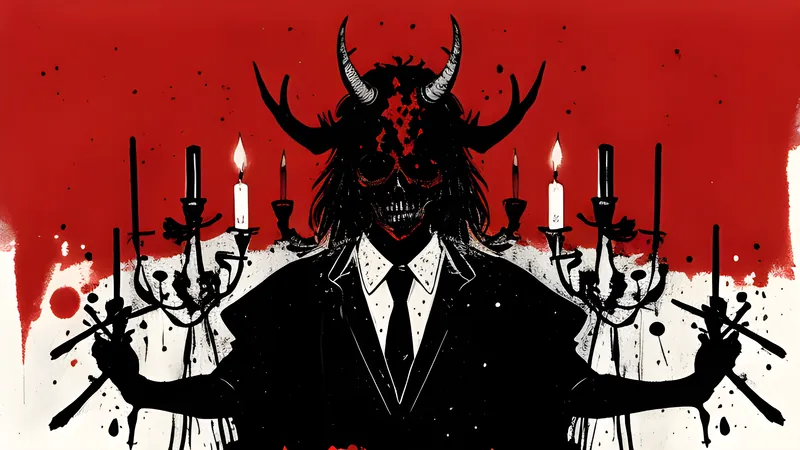
That ceremonial quality is central to Behemoth. Live, they are one of the most striking spectacles in extreme metal — corpse-paint and elaborate costume, incense and ritual staging, a stage dressed like a black mass. The corpse-paint itself connects them to a lineage that runs back further than most fans realise, to the Copenhagen horror-theatre of King Diamond and Mercyful Fate, who were painting their faces as characters years before the Norwegian black-metal scene made the look infamous. Behemoth inherited that visual language and pushed it toward something grander and more overtly liturgical.
The Bible, the stage, and the law
Here is the event that made Behemoth famous far beyond metal. In September 2007, during a concert in Gdynia, Nergal tore up a copy of the Bible on stage, called it “a book of lies”, and described the Catholic Church in withering terms. In most of Europe that would have been a provocative bit of stagecraft and nothing more. In Poland it was a potential crime.
Poland’s penal code contains Article 196, which criminalises “offending religious feelings” — a blasphemy law of a kind most of Western Europe abandoned long ago. A conservative campaigner brought a complaint, and Nergal found himself prosecuted by the state for what he’d done on stage. The case ground through the Polish courts for years. It was dismissed, appealed, sent up to the Supreme Court, retried, and Nergal was ultimately acquitted — the courts finding, in essence, that he had been performing as an artist and had not set out with the specific intent to wound the faithful that the law required.
The acquittal mattered well beyond one band. In a country where the Church holds real political weight, a metal musician had faced down a blasphemy statute in open court and won, and the case became a reference point in Poland’s long argument about free expression and the reach of religious law. Nergal has remained a repeat target of Article 196 in the years since — over artwork, over photographs, over merchandise — and he has fought each case rather than settle, turning himself into a kind of permanent stress test for the statute. Whatever you make of the provocations, the willingness to actually stand in the dock for them is real.
It’s worth being clear-eyed about all this. Behemoth’s anti-clericalism is theatre and it is also sincere, and reasonable people find the Bible-tearing either brave or crass depending entirely on where they sit. What isn’t in dispute is the factual record: a stage act, a prosecution under a real law, and an acquittal that carried genuine weight in a Catholic country. Behemoth turned their provocation into a legal argument and made the state come to them.
Nergal nearly dies, and the band makes its masterpiece
In 2010, at the height of all this, Nergal was diagnosed with leukaemia. It was serious enough to require a bone-marrow transplant, and for a while the future of the band was an open question — the frontman was fighting for his life, not touring. He recovered, and what he did next reframed the whole band.
The Satanist, released in 2014, is widely regarded as Behemoth’s masterpiece and one of the finest extreme-metal albums of its decade. It is looser, darker and more human than anything they’d made before — informed, plainly, by a man who had stared down his own death and come back. The Satanism on it reads less as adolescent provocation and more as a genuine philosophy of self-possession, defiance and refusing to kneel, which is a very different thing coming from someone who has just survived cancer. Critically it was a landslide, and it lifted Behemoth from respected extreme-metal veterans to something like elder statesmen of the form.
They followed it with I Loved You at Your Darkest in 2018 and Opvs Contra Natvram in 2022, keeping the ambition high and the spectacle enormous. Nergal, meanwhile, became a genuine public figure in Poland — appearing on mainstream television as a coach on a talent show, of all things, which only sharpened the strange double life of a man who is both a household name and a repeatedly-prosecuted blasphemer in the same country.
Where they land on a festival stage
Behemoth are one of the essential live acts in extreme metal, and they belong to a specific tier of festival headliner — the bands who can turn a main stage into a cathedral of smoke and ritual after dark. They are exactly the sort of act that anchors the heavier reaches of a bill like the one Copenhell assembles each June on the Copenhagen harbour, where the industrial setting and the after-dark slots suit their liturgical staging perfectly. Across the European extreme-metal circuit — the Czech and German and Nordic festivals where death and black metal draw their biggest crowds — Behemoth are a reliable high point, precisely because they treat the show as ceremony rather than a set of songs played in a row.
That commitment to spectacle is the connective tissue between the courtroom and the stage. Behemoth understand performance as a total act — the paint, the fire, the ritual, the willingness to make an audience uncomfortable and then defend it in front of a judge. It’s all the same instinct, scaled up.
The craft under the controversy
It would be easy, given the court cases and the corpse-paint, to treat Behemoth as a shock act first and a band second. That gets it backwards. The provocations only carry weight because the music underneath them is genuinely excellent, and Behemoth are, on pure musical terms, one of the most accomplished extreme-metal bands of their generation.
The blackened-death style they settled into is technically demanding — blast-beat drumming, intricate riffing, arrangements that shift between grinding brutality and slower, almost orchestral passages of dread. Their longtime drummer Inferno is a monster of precision, and the band’s recordings are dense, layered and meticulously produced, with none of the deliberate murk that a lot of black metal hides behind. Behemoth want you to hear every part clearly, because they’ve built every part to be heard. The Satanist in particular is an album of real compositional ambition, full of horns, choirs and dynamic shifts that reach well beyond the genre’s usual toolkit.
There’s also a discipline to how they present themselves that separates them from bands who trade purely on transgression. The imagery is consistent, the visual world is coherent, the records arrive polished and considered, and Nergal runs the whole operation with the seriousness of someone building a body of work rather than chasing a headline. The blasphemy that gets the press is one thread in a much larger, more careful project — a thirty-year exploration of the same handful of themes, self-possession, mortality, defiance, refined album by album. Strip out every court case and Behemoth would still be a major band. The controversy is loud, but the craft is what lasts.
Why Behemoth matter
Strip away the corpse-paint and the controversy and you’re left with a band that got better as it got older, made its finest work after its leader survived a life-threatening illness, and used its platform to test the actual limits of free expression in a country still governed, in part, by religious law. That’s a serious body of work by any standard.
Behemoth’s real subject, underneath the theatre, is autonomy — the right to say what you think about power, including sacred power, and to keep saying it even when the state drags you to court for it. A teenager from Gdańsk built a thirty-year career out of that conviction, nearly died halfway through, and came back louder. You don’t have to share a word of his worldview to recognise the thing he’s actually selling, which is nerve. Behemoth have plenty of it, and they’ve spent it in public, in front of the crowd and in front of the bench, for their entire career.