The Battle of the Oranges: Ivrea and the Carnival That Throws 500 Tonnes of Fruit
A Piedmontese town re-enacts a peasant revolt every February, and the ammunition is citrus
Contents
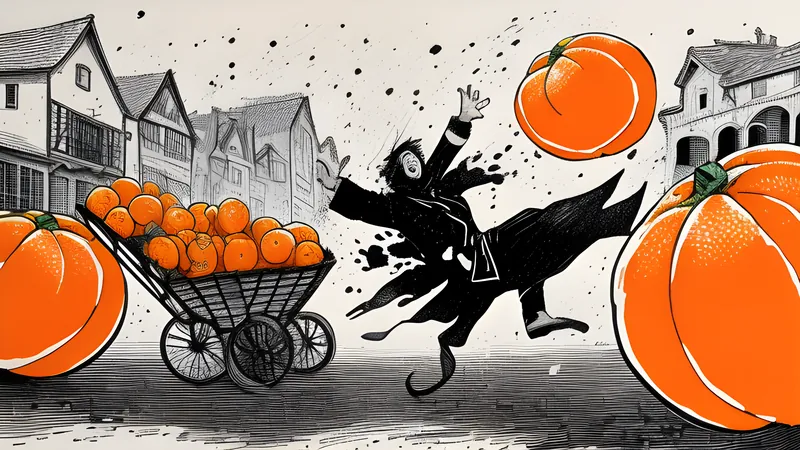
Every February a small town in Piedmont, at the mouth of the Aosta valley, spends three days pelting itself with citrus until the cobbles run with pulp and the whole place smells like a marmalade factory that has caught fire. This is Ivrea, an hour north of Turin, and the event is the Battaglia delle Arance — the Battle of the Oranges, the centrepiece of the Storico Carnevale di Ivrea. It is one of the oldest and by some distance the most violent-looking carnivals in Europe, and I have never been. I want to say that plainly, because the honest version of this piece is a correspondent’s read from the record, not a war story I have earned. What follows is the town’s own history, the mechanics of the fight, and why a place would agree, year after year, to bruise itself for a legend.
The legend under the fruit
Every good ritual has a story it tells about itself, and Ivrea’s is a revolt. The town says that centuries ago it was ruled by a tyrant — the accounts drift between a wicked marquis and a feudal duke — who claimed the droit du seigneur, the supposed right of a lord to the bride on her wedding night. His intended victim was Violetta, a miller’s daughter. She went to the castle as ordered, and when the tyrant reached for her she produced a knife, took his head off, and held it up from the tower window. The townspeople saw the signal, rose, and burned the castle to the ground.
That miller’s daughter is the Mugnaia, and she is the heart of the whole carnival. Each year a young married woman from Ivrea is chosen to play her, her identity kept secret until she is presented from the town hall balcony on the Saturday evening. Dressed in white with a red Phrygian cap, she rides through the packed streets on a gilded chariot, scattering sweets and mimosa, the queen of a revolution that may never have literally happened but is felt as true every single February. Whether Violetta existed is beside the point; the town has decided she is worth burning a castle for.
The oranges came much later. Early versions of the ritual involved townspeople flinging beans, then apples, in gestures whose exact meaning historians still argue over. Oranges arrived in the nineteenth century, and the folk explanation is satisfyingly bloody-minded: the fruit stands in for the stones and missiles hurled at the tyrant’s castle to bring it down, and, in some tellings, for the severed head itself. There is no orange grove within hundreds of kilometres of Ivrea. The most emblematic ammunition in Italian carnival is imported wholesale from the south, which tells you something about how seriously the town takes its own myth.
How the fight actually works
Strip away the legend and the mechanics are startlingly clean. The town divides into two sides with sharply unequal weapons, and the imbalance is the entire design.
On one side are the aranceri a piedi — the orange-throwers on foot. These are the revolutionaries, the people, and they fight bare-headed and bare-handed in nine historic teams, each with its own colours, name and back-catalogue of grudges. The teams are properly institutional: outfits like the Aranceri Asso di Picche (the Ace of Spades, founded 1947) and the Aranceri della Morte (the Death squad, 1954) have decades of history, thousands of members between them, and a fierce sense of turf. They mass in the town’s squares — Piazza di Città, Piazza Ottinetti, Piazza del Rondello, and more — and they wait.
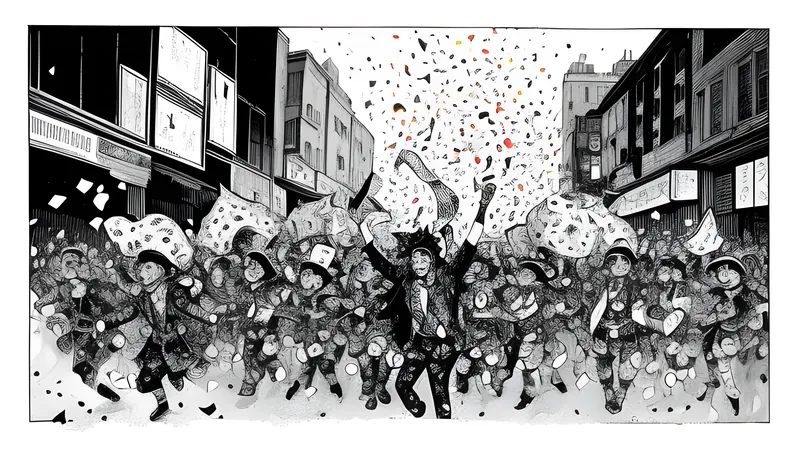
On the other side are the aranceri on the carts: the tyrant’s guards, armoured, helmeted, and mounted on horse-drawn carriages that grind through the squares in slow processions. The cart crews wear heavy leather and padded masks with metal grilles, because they are outnumbered fifty to one and everyone on foot is aiming at their heads. When a carriage rolls into a square, the foot teams unload. The carts fire back down into the crowd. For a few minutes each square becomes a genuine hailstorm of fruit, thousands of oranges in the air at once, splitting on helmets and shoulders and walls, and then the carriage lumbers on to the next square and the next ambush.
The mismatch is the whole point. The carts are the state, ponderous and armoured; the foot fighters are the mob, agile and furious and expendable. The revolt is re-fought over and over across the three days, and the people always, in a sense, win — because the carts keep coming and the town keeps throwing. It is choreography that looks like chaos, which is the hardest kind of choreography there is.
The red cap, and how not to get hit
Here is the practical detail that makes Ivrea navigable, and the one every visitor needs before setting foot in a square: the red hat. Anyone who does not want to be pelted wears a berretto frigio, a soft red Phrygian cap — the same liberty cap worn by French revolutionaries and, not coincidentally, by the Mugnaia herself. The cap marks you as a citizen who has already joined the revolution, a non-combatant under the town’s unwritten treaty. In principle, throwers do not aim at red caps.
In practice, an orange thrown hard by an excited teenager does not always respect the treaty, and the squares during the battle are no place for anyone unwilling to be hit. The town is honest about this. Barriers and netting protect the marked-off spectator lanes, the red cap is sold on every corner in the days beforehand, and the safest way to watch is from behind the nets with the cap jammed firmly on your head. Ivrea does not pretend the fruit is soft. A February orange, chilled and dense, thrown from two metres, is a real projectile, and the town wears its bruises through Lent as a badge.
If you want a Nordic comparison for the crowd dynamics — an event where the danger is the draw and the safety is engineered underneath the spectacle — the fire-and-effigy traditions I have written about work the same way. The Shetland Vikings of Up Helly Aa march a thousand torches through a wooden town with the same trust in choreography over chaos, and the Alpine Krampus runs send horned devils charging a crowd that has agreed, in advance, to be charged.
What the town is really doing
It would be easy to file Ivrea under “mad Italian festival” and move on, and the international coverage mostly does. Photographers arrive for the arterial-red squares and the dramatic close-ups of split fruit against leather armour, get their shots, and leave with a gallery and no idea what they watched. I think that misses the actual thing.
Ivrea is a town performing its own political memory. The battle is a licensed riot, a controlled re-enactment of the moment a community decided a ruler had gone too far and pulled him down. It is staged annually so that the town never forgets it is capable of that. Carnival across Catholic Europe has always been the season when the ordinary order is turned upside down — the poor crowned, the powerful mocked, the rules suspended for a few days before Lent clamps back down. Most towns express that with masks and costume. Ivrea expresses it by arming its citizens with fruit and letting them re-fight a revolution in the street.
That is why the imported oranges and the secret Mugnaia and the nine ancient teams all matter more than they should. The event is expensive, exhausting, genuinely bruising, and utterly non-negotiable to the people of Ivrea, because it is the shape their town’s idea of itself takes once a year. The famous figure — some hundreds of tonnes of citrus, the exact number climbing with every retelling and every wire report — is almost beside the point. What is being thrown is not really fruit. It is the memory of saying no to a tyrant, made physical and hurled at an armoured cart until it hurts.
Going, if you go
The battle runs across the Sunday, Monday and Shrove Tuesday before Ash Wednesday, so the dates shift with Easter each year. Ivrea is easy to reach — a direct train from Turin, itself an hour off the main European lines — which is part of why the crowds have swollen and the town now manages the event with the seriousness of a small war. If you go to throw, you join a team, and you commit to the whole three days and the bruises that come with them. If you go to watch, you buy the red cap, stand behind the nets, and accept that a stray orange is part of the ticket.
I would like to see it one February, and if I do I will write the version I have earned, from a square with pulp in my hair. Until then this is the honest account: a correspondent’s read of a town that agreed, long ago, to hurt itself a little every year rather than forget what it once found the nerve to do. For more of these strange, joyful, faintly dangerous gatherings — the ones where a whole community consents to the same beautiful ordeal — the Danish bonfire night of Sankt Hans sits at the calm end of the same instinct, and the Krampus runs of the Alps at the loud one.
Related Content