Amon Amarth: Viking Metal as a Stadium Sport
How a melodic death metal band from Tumba built the loudest longship in Europe
Contents
At some point in the last decade a Swedish death metal band from a Stockholm commuter suburb started arriving on stage inside a giant Viking helmet, flanked by inflatable warriors and a longship, and the crowd started rowing. Actual rowing. Thousands of people sitting on the floor of a festival field, pulling imaginary oars in time. That is Amon Amarth in 2023, and getting there took thirty years of very committed hard work.
The band come from Tumba, a town south of Stockholm, and they formed in 1992 out of the wreckage of an earlier group. Their subject was fixed from the start and has never wavered: Norse mythology, Viking history, gods and battles and the long ships going out. For most of the nineties and early 2000s they were a respected but mid-tier melodic death metal act, one of a great many Swedish bands playing furious, tuneful, downtuned metal to a devoted underground. What separated them in the end was not a change of sound. It was ambition about the show.
Melodic death, sung by a mountain
Musically, Amon Amarth sit in the melodic death metal tradition that Sweden turned into a national export in the nineties. Twin-guitar harmonies that gallop and soar, riffs built for momentum, and over the top of it all the voice of Johan Hegg — a full, roaring death growl delivered by a genuinely enormous bearded man who looks exactly like the music sounds. Hegg’s growl is one of the more intelligible in the genre, which matters when your lyrics are essentially compressed sagas. You can follow the story.
The rhythmic identity is the mid-paced march. Where a lot of death metal races, Amon Amarth tend to plant their feet and stomp, riffs pitched at the tempo of an advancing army rather than a sprint. That choice is central to why the songs work in a stadium. A blast-beat flurry loses definition across a hundred metres of open field; a slow, heavy, hammering riff carries to the back fence and gives ten thousand people something to nod their heads to in unison. Amon Amarth write for the physics of the big room, and the deliberate pace is a feature engineered into the sound.
The melodic death lineage is worth pinning down, because Amon Amarth get filed next to the Gothenburg sound that acts like In Flames, At the Gates and Dark Tranquillity built on the country’s west coast. Amon Amarth are Stockholm rather than Gothenburg, and their take is heavier and more anthemic than the classic Gothenburg template, but the shared vocabulary is obvious — the harmonised leads, the sense of melody riding on top of aggression. Where the Gothenburg bands often wrote about alienation and inner weather, Amon Amarth wrote about Odin. That single decision, to make the whole thing a mythological spectacle, is what eventually turned them into arena headliners.
The records tell the climb. Once Sent from the Golden Hall in 1998 established the template. Album by album they got tighter and bigger, and 2008’s Twilight of the Thunder God was the breakthrough — a title track that functions as a pure singalong, the god Thor fighting the world serpent set to a chorus a stadium can bellow. From there the trajectory was steep. Jomsviking in 2016 was a full concept album, a fictional Viking’s revenge saga. Berserker in 2019 cemented them as a festival-headline act.
What is striking about that discography is how little the band changed the formula and how much they refined it. Amon Amarth have essentially made the same album, better, for thirty years. The tempos, the twin-guitar melodies, the mid-paced martial stomp, the Norse subject matter — the ingredients barely move. What improved was the execution: sharper hooks, bigger production, choruses honed to land in a field. In a genre that often prizes reinvention, Amon Amarth’s stubborn consistency is a strength. You know exactly what you are getting, and a crowd that knows exactly what it is getting is a crowd that sings every word. There is a reason their audience skews toward the loyal lifer rather than the trend-follower. This is a band you commit to.
The show is the point
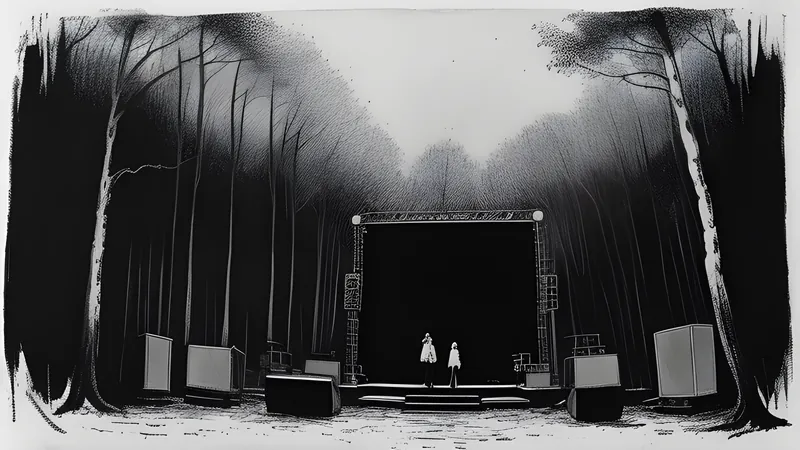
Here is where Amon Amarth become genuinely special, and where I will happily set aside any critic’s reflex to be cool about it. Their live show is one of the best-designed spectacles in metal. They understood, earlier and more completely than most heavy bands, that if your subject is Vikings then the show should look like Vikings, and they built it out with real theatrical craft — the oversized helmet, the props, the flames, the whole 300-meets-metal staging.
The masterstroke is participation. Amon Amarth’s set is engineered to give the crowd things to do. The rowing during “Put Your Back Into It” is the famous one — the entire audience sits down and mimes rowing a longship — and it turns a passive crowd into a working ship’s crew. This is the same instinct that powers a good wall of death: give thousands of strangers a shared physical ritual and the room becomes a single organism. Amon Amarth just dress theirs up in furs. Few bands have thought as hard about what the crowd is physically doing for ninety minutes, and it is the reason their live reputation now outstrips their record sales.
I have watched this land across the festival circuit and it works every time, on hardened metalheads and curious first-timers alike. The genius is that the theme gives everyone permission to be daft in a way heavy music usually resists. Nobody feels self-conscious rowing a longship, because the whole field is doing it, and for four minutes a muddy European festival becomes a raiding party. That is a hard feeling to manufacture, and Amon Amarth manufacture it on a schedule.
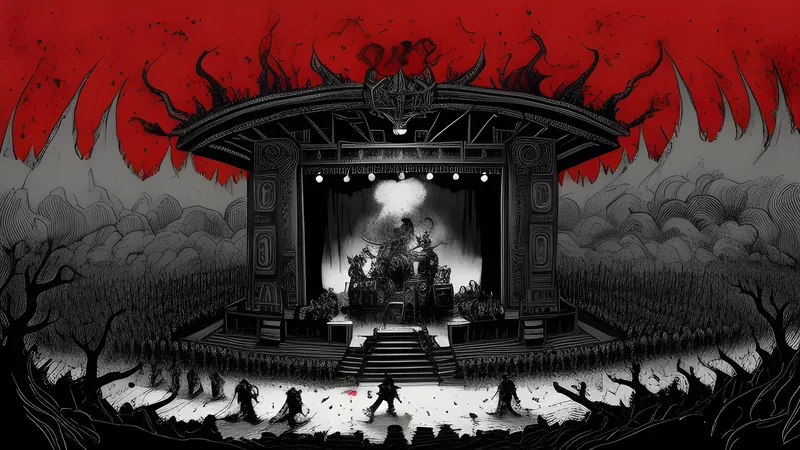
The staging has escalated over the years into something close to a theatre production. Recent tours have featured enormous set-pieces — a horned drum riser, animatronic props, a stage dressed as a burning Norse hall, pyrotechnics timed to the choruses. Johan Hegg, all beard and forearms and easy authority, works the front of it like a chieftain addressing the assembly. He does not run around much; he does not need to. He plants himself, raises a horn, and the field responds. It is a lesson in stagecraft economy, and it is the payoff of thirty years spent working out exactly what a Viking metal show is supposed to feel like.
Corny on paper, magnificent in the field
You have to be honest about the risk here. Viking metal is one bad decision away from LARP, and there are nights and merch stalls where Amon Amarth flirt with the line. The plastic hammers, the horned-helmet clichés the actual Vikings never wore, the sheer relentlessness of the theme. On paper it should be exhausting. In the field it is magnificent, and the reason is commitment. The band play it completely straight, the musicianship underneath is genuinely excellent, and the songs are good enough to survive the pageantry. Take away the longship and “Twilight of the Thunder God” is still a great metal song.
That balance — total theatrical commitment resting on real songwriting — is the thread that ties the biggest Swedish exporters together. It is the same engine driving Sabaton, Falun’s war-metal machine, and the same instinct for spectacle that made Ghost a Grammy band. Sweden keeps producing metal acts that treat the live show as a designed experience rather than an afterthought, and Amon Amarth are the purest example. They spent thirty years building the loudest longship in Europe, and now they sail it into a different festival field every weekend.
There is a lesson in their patience that younger bands would do well to study. Amon Amarth did not arrive fully formed as arena headliners; they served a fifteen-year apprenticeship in club rooms and mid-afternoon festival slots, playing to a few hundred people while they refined both the songs and the show. The breakthrough with Twilight of the Thunder God looked sudden from outside and was anything but. By the time the wider world noticed them, they had already worked out precisely what they were and how to deliver it, so when the bigger stages came they were ready to fill them. Overnight success, in metal as elsewhere, usually takes about a decade and a half of unglamorous graft.
The Norse revival they helped drive has since become a whole cottage industry — folk-metal bands, Viking-themed festivals, an entire aesthetic of runes and horns and mead. Plenty of bands had sung about the old gods before them; Amon Amarth were the ones who proved the theme could headline. A great deal of what now passes for “Viking metal” is downstream of the template they hammered out in Tumba: melodic death metal, sung by a giant, dressed as a saga, engineered so the whole field can join the raid.
The crowd rows. The helmet lights up. A death metal band from a Stockholm suburb has somehow made you feel, for the length of one song, like you are pulling for shore with a hold full of plunder. Corny is one word for it. Unforgettable is the more accurate one.
Related Content