Amager Bio: Copenhagen's Perfect Mid-Size Room
The Amager cinema that traded film reels for a 1,300-capacity live floor
Contents
Cross the bridge onto Amager, walk down Øresundsvej past the kebab shops and the metro rumble, and you arrive at a squat interwar block that still wears the word BIO across its face like an old cinema keeping its maiden name. That is exactly what it is. Amager Bio opened as a picture house in 1941, ran film for forty-five years, and then reinvented itself as one of the most useful concert rooms in Denmark — the venue Copenhagen reaches for when a band has outgrown the clubs and isn’t ready to fill an arena. I’ve lost count of the nights I’ve spent on that sloping floor, and I keep coming back to the same verdict: for the mid-size touring show, this is close to the ideal Copenhagen room.
“Useful” sounds like faint praise. It isn’t. The gap between a 500-capacity sweatbox and a 12,000-seat shed is where most of the best live music of your life actually happens, and Copenhagen has surprisingly few rooms built to catch it. Amager Bio is one, and understanding why means going back to what it was built to do.
From German concrete to a supermarket that never came
The building went up in 1939–41, a bold slab of a thing that locals nicknamed for its heavy interwar concrete, and it did the ordinary work of a neighbourhood cinema through the war and the decades after. In 1976, fighting the same losing battle every cinema fought against television, it split its single auditorium into two halls of around 375 seats each. That bought it a decade. By January 1986 the game was up: the building was sold to become a supermarket, and Amager Bio looked set to end as shelving and strip lighting.
It survived because the Sundby local council dug in. They blocked the conversion, argued the building’s cultural worth, and the City of Copenhagen brokered a deal for continued cultural use. That fight is the reason the room exists at all, and it explains something about the place’s character — Amager Bio belongs to a working-class district that decided, deliberately, that it would rather keep a hall for music and film than gain another grocer. It reopened for concerts in 1997 and has been a fixture of the Copenhagen live circuit ever since.
Knowing the cinema origin helps you read the room the moment you walk in. The floor rakes gently down towards the stage — a slope built for sightlines to a screen, now doing the same favour for sightlines to a band. That single inherited detail is half of why Amager Bio works so well.
The floor, the slope, and why sightlines matter
Here is the thing nobody tells you until you’ve suffered without it: the enemy of a flat-floored standing venue is the person in front of you. Get a tall crowd on level ground in a 1,300-capacity room and anyone under six foot spends the night watching shoulder blades. Amager Bio’s raked floor quietly solves that. Because the ground drops away towards the stage, you’re always looking slightly downhill at the band, and the wall of heads in front of you sits a little lower than you do. You can see. In a room this size, being able to see the drummer’s hands is not a small luxury.
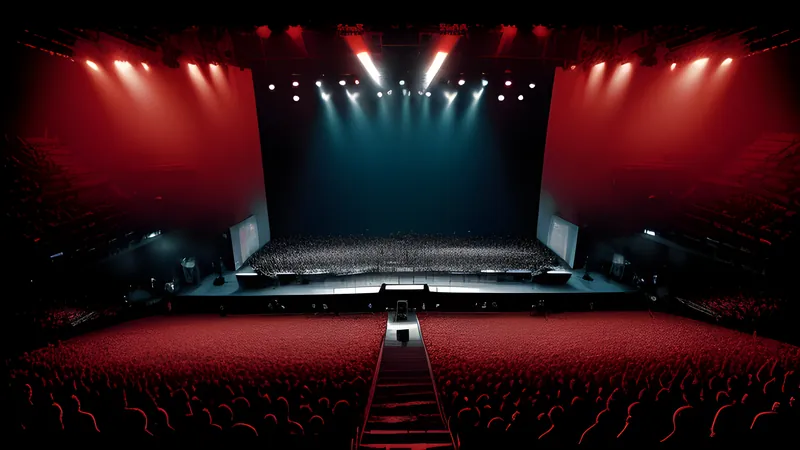
The capacity sits at roughly 1,300 standing after a 2018–19 refurbishment that pushed the number up from around 1,100, with a seated configuration closer to 700 for the shows that want chairs. That band of capacity is the sweet spot of touring music — big enough that international acts on the way up will route through it, small enough that you’re never more than thirty or forty metres from the stage. Stand two-thirds back and you get the whole picture: the light rig, the crowd, the shape of the set. Push to the barrier and you’re close enough for the show to become physical.
The sound is honest and loud rather than boutique. This is a reconfigured cinema, not a purpose-built acoustic jewel like VEGA across the water in Vesterbro, and on the heaviest bills the low end can pile up towards the back corners the way it does in most rectangular halls of this vintage. But the house PA is competent, the engineers know the room, and out on the main floor the mix is punchy and clear. For loud guitar music — which is most of what I go there for — it delivers exactly the wallop you want.
There’s a detail worth clocking about the room’s shape, too. Because it started as a single-screen picture house before that 1976 split into two halls, the auditorium has the generous height and depth cinemas were given so a projected image could breathe. That volume of air overhead does the sound a quiet favour: there’s room for the noise to develop rather than slamming straight off a low ceiling, which is a big part of why the mix keeps its shape even when the floor is jammed. The high stage helps as well. You’re looking up at a proper elevated platform, cinema-screen height, so even from the back of a full house the band stays in view — a second inheritance from the film years that pays off every single night.
Beta next door, and the Amager double bill
Amager Bio doesn’t travel alone. Bolted onto the operation is Beta, a 200-capacity club that has run since 2010 and handles the underground and upcoming end of the programme — the niche metal, the emerging Danish acts, the touring bands still measured in dozens rather than hundreds of tickets. Together they trade as AB&B, Amager Bio & Beta, and the pairing is smart: Beta is the room where you catch a band the first time, Amager Bio the room where you catch them once they’ve earned the step up.
That ladder matters for anyone who cares about where careers actually start. The Copenhagen scene runs on rooms like Loppen in Christiania and Stengade in Nørrebro for the very small shows, then hands bands up to Beta and Amager Bio as they grow. Watch the same act climb that ladder over three or four years and you understand the ecosystem better than any think-piece could teach you.
The programming across the main room is genuinely broad — everything from death metal to the softest indie pop passes through — but Amager Bio has always been a reliable metal and hard-rock address. This is the size of room where the Danish loud-music tradition lives when it’s not filling stadiums: the acts documented in the story of Denmark’s outsized metal export mostly cut their teeth on floors exactly like this one. When homegrown heroes such as King Diamond and Mercyful Fate or a hungry younger band come through town at this scale, Amager Bio is where the night tends to land.
Where to stand, and how to work the night
A few hard-won notes. The bar is set back and the queues are civilised by Copenhagen standards, but the floor empties towards it between bands, so if you want to hold a good spot, send one person and stay put. The best sightline-to-sound compromise is dead centre, roughly a third of the way back, where the slope has lifted you above the front crush and the PA has resolved into a proper stereo image. If you want the show in your chest, go left or right of centre at the barrier — the middle-front can get a heaving, and on a hard bill the pit opens up there fast.
Getting home is easy, which is more than you can say for a lot of European venues. The Amagerbro metro station is a short walk, the trains run late, and the bridge back to the city centre is quick by bike if you rode over. Eat before you arrive — Amagerbrogade outside the door has decent cheap food, and the in-venue options are the usual functional beer-and-a-snack affair rather than a destination.
The crowd is a big part of the appeal, and it’s a distinctly Amager crowd. This is a residential, unpretentious, slightly out-of-the-way corner of Copenhagen, so the room fills with people who came specifically for the band rather than for a night of being seen in the fashionable part of town. That gives Amager Bio gigs a warm, committed, low-ego atmosphere. Nobody’s here by accident. They crossed the bridge on purpose, they know the act, and they respond accordingly — which is exactly the energy a touring band wants to walk out into. On the best nights that shared intent turns the whole raked floor into a single moving thing, and you remember why you keep making the trip to a converted cinema on the wrong side of the water.
What keeps me loyal to Amager Bio is that it never pretends to be more than it is. It’s a converted neighbourhood cinema that a working-class district refused to let die, tuned by accident and renovation into one of the best mid-size rooms in the country. You get a clean sightline, an honest wall of volume, a step on the ladder that runs from the back room at Beta all the way up to the arenas, and a crowd that came to watch the band rather than to be seen. On the right night, with the right loud guitars pouring off that raked floor, there’s nowhere in Copenhagen I’d rather be standing.
Related Content