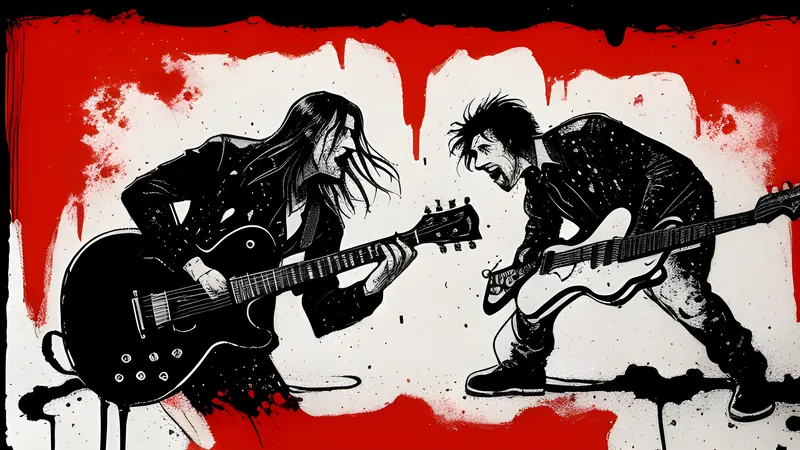
Airbourne: AC/DC's Torch Carried at Full Sprint
The Australian hard-rock band who took one very old idea, refused to complicate it, and became one of the most physical live acts in the world
Contents
Somewhere in the seaside town of Warrnambool, on the wind-scoured southern coast of Victoria, a teenager named Joel O’Keeffe decided that the finest musical idea in human history had already been discovered by AC/DC in the 1970s and required no improvement whatsoever. Two decades on he is still making that case, and he makes it by walking out on stage every night with a guitar and a bottomless supply of certainty. Airbourne are not the most sophisticated band you will ever see. They may be the most committed.
A very old blueprint, followed to the letter
Airbourne formed in Warrnambool in the early 2000s around the O’Keeffe brothers, Joel on lead vocals and lead guitar and younger brother Ryan on drums, and they have never once pretended to be doing anything other than continuing the tradition of high-voltage Australian pub rock. The debt to AC/DC is total and completely unhidden. The barking vocals, the four-square riffs, the schoolboy-glee lyrics about drinking and rocking and rocking while drinking, the refusal to add a keyboard or a ballad or a moment of introspection: it is the AC/DC template, specifically the raw Bon Scott-era version, run forward into a new century at a dead sprint.
Purists sometimes sneer at this. I understand the reflex and I think it misses the point. There is a difference between a tribute act and a band that has genuinely internalised a form and can generate new, convincing material inside it, and Airbourne are firmly the latter. Their debut album Runnin’ Wild arrived in 2007 and announced the whole project in its title. It was followed by No Guts. No Glory. in 2010, Black Dog Barking in 2013, Breakin’ Outta Hell in 2016 and Boneshaker in 2019, and across all of them the mission statement never wavers by a degree. You do not go to Airbourne for surprises. You go for reliability of a very high order.
The line-up settled early, with bassist Justin Street joining in the mid-2000s and the band touring behind their records almost continuously ever since. That relentlessness is the family resemblance to the acts that actually last. The great hard-rock institutions are built on the road, and Airbourne understood from the beginning that the way you carry a torch is by never putting it down.
The stunt that is not really a stunt
Airbourne’s live reputation rests on one image above all others, and it is worth explaining carefully because it sits so close to the line between showmanship and sheer daftness. Joel O’Keeffe plays a lot of the set from the crowd. He climbs the PA stacks, he is carried out over the audience on the shoulders of a roadie while still soloing, and at some point most nights he takes a full, unopened can of beer and smashes it against his own forehead until it splits, then drinks whatever survives.
It should be ridiculous. Somehow it is magnificent. The head-crushing beer-can routine has become a signature, the thing casual observers know Airbourne for even if they could not name a song, and it works because O’Keeffe commits to it with the same absolute conviction he brings to the riffs. There is no wink, no irony, no sense that the band find their own excess funny. They mean it, and meaning it is the whole trick. A knowing version of this would be unbearable. The straight-faced version is one of the more purely joyful things on the festival circuit.
I want to be careful here, in keeping with how this desk works: I am describing the documented, repeated features of an Airbourne show, the climbing and the beer-can gag that anyone who has seen them or watched a live clip will recognise, not inventing a specific dated incident. The point is that Airbourne have built a live identity out of physical recklessness performed with a completely straight face, and that identity is remarkably consistent from show to show.
The songs, and why the simplicity is a discipline
It is easy to dismiss Airbourne’s writing as three chords and a shout, and easy to be wrong about how hard that actually is. Writing a genuinely good, memorable, four-square hard-rock song is one of the most unforgiving jobs in music precisely because there is nowhere to hide. You cannot bury a weak idea under a clever arrangement or a key change or a string section. The riff either works or it does not, the chorus either lodges or it evaporates, and the vast majority of bands who try this end up sounding like a pale photocopy.
Airbourne clear that bar more often than they have any right to. “Runnin’ Wild”, “Too Much, Too Young, Too Fast”, “Live It Up”, “Ready to Rock”: these are proper hard-rock songs, built to be bellowed back by a field of people, and they hold up across repeated listens in a way pastiche never does. Joel O’Keeffe writes with a real ear for the singalong, and his playing, the thing that sometimes gets lost behind the beer-can theatrics, is genuinely excellent, fast and clean and rooted in the Angus Young school without being a slavish copy. The band understood early that the discipline of the form is the point. You do not decorate this music. You perfect it, or you fail, and Airbourne mostly perfect it.
There is also a self-awareness under the bravado that keeps them likeable. They know exactly what they are, they have never once claimed to be reinventing anything, and there is something refreshing about a band with zero pretension in an art form that often drowns in it. They turn up, they plug in, they detonate, they go home. It is an honest transaction, and audiences reward honesty.
Why it lands with a festival crowd
Put Airbourne on a big outdoor stage in the afternoon and something clicks. They are close to the ideal daytime festival band, the kind of act you programme when you want to detonate a field of people who have been standing in the sun since noon. The songs are simple enough to grasp on first hearing, physical enough to move to, and delivered with an energy that is frankly contagious. They have earned that slot at the large European gatherings, the AC/DC-worshipping heartland of Germany especially, where the Wacken sort of crowd receives this music like scripture.
If you have read this desk’s account of how a German village hosts 85,000 metalheads, you already know the ecosystem Airbourne thrive in, a culture that treats old-school, no-nonsense, high-volume rock as a serious business worth travelling across a continent for. Airbourne are a perfect fit for it because they take the fun seriously. There is craft under the daftness, in the tightness of the rhythm section and the genuine quality of O’Keeffe’s playing, and a festival audience feels that even while it is mostly there to punch the air.
The honest verdict
You can hold two things in your head about Airbourne at once. The first is that they are, by design, one of the least original bands working, a group whose entire artistic proposition is the faithful continuation of someone else’s sound. The second is that this does not matter even slightly, because the thing they continue is a genuinely great tradition of physical, generous, uncomplicated rock, and they do it better than almost anyone else currently alive.
There is a longer tradition behind them worth naming, because Airbourne did not appear from nowhere. Australia has produced a specific lineage of hard, unpretentious pub rock going back to the 1970s, bands raised in loud rooms full of people who came to drink and move, and that environment breeds a certain kind of music: direct, physical, built for volume, allergic to art-rock indulgence. AC/DC are the summit of that tradition, but they are the top of a whole mountain of Australian bands who played the same rooms, and Airbourne are the most successful modern inheritors of the entire scene, not just of one famous band. Understanding that context makes their faithfulness read less like imitation and more like a young band taking up a regional craft and keeping it alive.
Not every band needs to reinvent the form. Some are custodians, keeping a flame lit for the next audience that has not heard the original yet, and there is real value in that job. Airbourne belong beside the other torchbearers this desk keeps returning to, the acts who take a proven blueprint and pour everything they have into executing it, in the same spirit as Denmark’s own AC/DC-descended export machine Volbeat. If you want spectacle with a flamethrower and a concept, look elsewhere on the bill. If you want a man to crack a beer can on his head, solo from the top of the speakers and mean every second of it, Airbourne have you covered, and they always will.
That reliability is the whole pitch, and it is worth more than novelty. A festival programmer knows precisely what an Airbourne set will deliver, an audience knows precisely what they are buying, and the band deliver it every single time without fail or excuse. In a live-music economy full of acts trying to be everything at once, there is a real and underrated pleasure in a band who decided long ago exactly what they are, got very good at it, and never looked back. Airbourne carry an old torch at a full sprint, and they have never once let it drop.
Related Content