2000trees: The Friendly British Loud Weekend
How a green-minded Gloucestershire festival became the most quietly beloved rock weekend in Britain
Contents
Ask around the British rock scene for the festival everyone privately loves and someone will say 2000trees before you finish the sentence. It has none of the scale of the giants and none of the swagger. What it has is a reputation for being genuinely, almost suspiciously, nice, which in the modern festival economy is close to a miracle. It runs every July on Upcote Farm at Withington, a village up in the Cotswolds outside Cheltenham, and it has spent the better part of two decades proving that you can build a loud, sold-out festival without cynicism as the foundation.
The name is not decoration. When a group of Gloucestershire friends started the festival in 2007 they built the whole thing around an environmental ethic, and the tree in the title was a literal commitment to offsetting and greenery long before that became a marketing box to tick. Local suppliers, serious recycling, a refusal to let the site turn into a sea of abandoned tents. The first edition was tiny, around a thousand people, a proper cottage-industry affair run by enthusiasts who wanted the festival they themselves would want to attend. That origin still shapes everything about how the place feels, and it explains why the festival has always behaved more like a co-operative than a business.
Small on purpose, for a long time
For years 2000trees deliberately stayed small, and the restraint was the point. The founders understood something that the corporate festivals have had to relearn the hard way: past a certain size, a festival stops being a community and becomes a logistics problem with a stage attached. They grew slowly, capacity creeping up only as the infrastructure could genuinely support it, and by holding that line they kept the atmosphere that made the early years special. The festival now runs at something in the region of fifteen thousand, which is large enough to book real headliners and small enough that you keep bumping into the same people all weekend.
That word-of-mouth loyalty is the festival’s entire engine. 2000trees barely advertises. It sells out on the strength of people who went once and told everyone they knew, which is the hardest kind of growth to buy and the most durable kind to have. The organisers lean into it, running the whole thing with a transparency that borders on confessional, publishing their thinking on ticket prices and lineups and treating the audience like partners rather than a revenue column. It shares its DNA with ArcTanGent, the more technical festival run by the same crew, and the two together represent the healthiest corner of the British independent festival world.
The Forest Sessions and the geography of intimacy
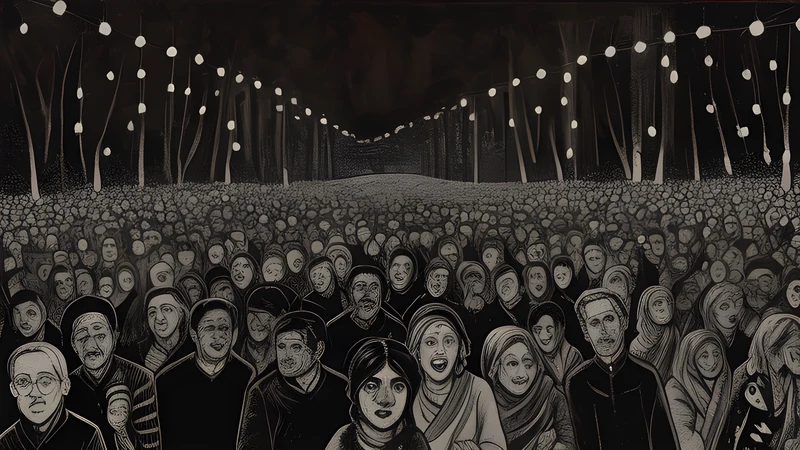
The single best idea 2000trees ever had is a stage in the woods. The Forest Sessions take place on a small platform deep in the treeline of the Upcote site, and they are where the festival’s soul lives. Bands who spend the day being loud on the main stages come down to the forest at night and play stripped-back acoustic sets to a few hundred people sitting on the ground among the trees, lit by string lights and whatever the moon provides. It is the kind of setting that could easily tip into twee, and somehow it never does, because the music is real and the crowd is reverent. The Forest Sessions have become the thing regulars talk about first, the sets they queue an hour early to get near, and other festivals have spent years trying to bottle the same magic without quite managing it.
The rest of the site is designed around the same instinct for closeness. The Main Stage and the Cave and the Axiom and the various smaller stages sit near enough that you never face the exhausting cross-country marches that define the mega-festivals. You can catch the end of one band and the start of another without missing anything. That compactness changes the whole rhythm of the weekend. You wander, you stumble into bands you had no plan to see, and because everyone else is doing the same the crowds shuffle and mix rather than staking out territory. It is the physical layout of a festival that actually wants you to discover things.
What loud means here
The booking policy sits in the broad church of British guitar music: post-hardcore, emo, punk, metalcore, indie with teeth, the occasional heavier band, and a healthy stream of the country’s best up-and-coming acts. Frank Turner, the Hampshire folk-punk troubadour, is close to a patron saint of the place and has played many times in many forms, from full-band headline sets to solo appearances in the forest. Enter Shikari, the St Albans band who fused post-hardcore with electronics, are festival favourites. Acts like While She Sleeps, Boston Manor and a rotating cast of the scene’s rising names fill out bills that consistently punch well above the festival’s size.
What 2000trees does better than almost anyone is treat the bottom of the bill as seriously as the top. This is a festival where an unsigned band on the smallest stage at two in the afternoon can walk off to a genuine buzz, because the crowd came predisposed to give new bands a real chance. That generosity toward emerging acts is exactly the instinct I try to carry into every gig back home, first through the door for the openers, and it is baked into the culture at Upcote. The result is a festival that functions as a genuine escalator for British rock, the place where a band’s summer stops being a slog and starts being a breakthrough. Half the mid-tier bands on the British touring circuit can point to a 2000trees set as the weekend the numbers started to move.
The practical texture of Upcote
The site itself does a lot of quiet work. Upcote Farm is a working farm on rolling Cotswold ground, and the festival occupies it for a few days a year with a light footprint that reflects the founding ethic. The camping fields slope gently, which every experienced festivalgoer knows is a mixed blessing, water runs off but you spend the weekend fighting gravity in your sleeping bag. The main arena sits in a natural bowl that helps the sound and gathers the crowd, and the walk from the furthest campsite to the stages is measured in minutes rather than the demoralising treks that define the giant sites.
Food and drink lean local and independent, another founding commitment that has aged into an asset now that the big festivals all seem to serve the same three catering conglomerates. The bars pour regional ales alongside the usual lager, and the traders are small operators rather than branded concessions. It costs the festival some efficiency and it buys character, which is precisely the trade a place like this exists to make. The weather, of course, does whatever it wants. Mid-July in Gloucestershire can deliver a heatwave or a washout, sometimes in the same afternoon, and part of the festival’s reputation rests on how gracefully its crowd handles a soaking.
Manners as a business model
The friendliness is deliberate, and it is tougher than it looks. It is enforced, gently, by a culture the organisers have spent nearly twenty years cultivating. The crowd polices itself. The bins get used. The atmosphere in the campsite has none of the low-level menace that curdles the edges of a bigger event. I have written about the sociology of the festival tent city and how quickly a campsite reveals a festival’s real character, and 2000trees consistently reveals a good one. People look after each other’s stuff. The queues are civil. It sounds trivial until you have spent a weekend somewhere it is absent.
That civility is a competitive advantage in a market that has largely forgotten it exists. As the big festivals consolidated under a handful of corporate owners and started to blur into interchangeable branded experiences, a subject I have chewed over at length in why every festival now feels the same, the independents that survived did so by offering the one thing scale cannot manufacture, which is a sense that the people running the festival actually care whether you have a good time. 2000trees has that in abundance, and it converts directly into the loyalty that keeps the gates open.
A home for a scene without a home
There is a particular strand of British loud music that has never had a natural festival home. The post-hardcore, emo and metalcore bands that fill the mid-tier of the touring circuit are too heavy for the indie festivals and too melodic for the metal ones, and for years they fell through the gap. 2000trees became the place that gap closed. It gave a genuine scene, one with its own venues and its own devoted, tattooed, sing-every-word audience, an annual gathering where those bands headline rather than warm up. That sense of belonging is why the crowd is so protective of the place.
It sits at an interesting distance from the big beasts of the British calendar. Where Reading and Leeds function as a mass-market rite of passage for teenagers, 2000trees is the festival those same fans graduate to a few years later, once they have worked out exactly what they like and stopped wanting to fight for it in a crowd of ninety thousand. It is the connoisseur’s version of the same instinct, smaller, warmer and pointed squarely at the music rather than the spectacle.
The stubborn independent
There is a wider point buried in the success of a festival like this. The British festival landscape has been through a brutal decade. Costs have soared, insurance has become punishing, the weather has stayed reliably terrible, and a long list of mid-sized festivals have folded or been swallowed. That 2000trees survived and then thrived, without selling its independence, is a genuine achievement and a quiet rebuke to the idea that scale is the only path to safety. It stayed solvent by staying honest with its audience and refusing to grow faster than its character could bear.
None of this makes it the biggest weekend on the calendar or the loudest. It makes it the one people mean when they say a festival changed how they think about festivals. For a certain kind of British music fan, the Cotswolds in July, the forest stage at midnight, and a crowd that would sooner help you pitch your tent than nick your beer add up to the platonic ideal of what a festival is supposed to be. Everyone should have one they love like that. A lot of people have this one.
Related Content